We are seeking experienced Software Engineers to contribute to projects across a wide range of technologies and programming languages, including JavaScript, Python, Go, C++, Ruby, and more. This is an open-ended contract opportunity, structured around project-based work with no set schedules or minimum time or task commitments. Contributors who work with us decide which available projects they’d like to work on, when they work, and how much they contribute, which makes it an excellent option for those seeking flexible and high-impact work. In this role, you will help advance AI research by understanding complex systems, exploring large codebases, and developing approaches to verify the correctness of software behavior.
Compensation
$70 per hour after passing the qualification
Fully remote
Project based work, no minimum time or task commitments
Responsibilities
Rapidly build context in large, multi-module codebases
Analyze feature implementations for correctness and edge cases
Produce clear, structured documentation of findings and rationale
Requirements
Bachelor’s degree in Computer Science or a related field
At least 2 years of experience as a Software Engineer
Excellent written communication skills
Ability to clearly explain complex technical concepts
Location
Remote in the US, UK, Canada, Europe, Australia, or New Zealand
We’re looking for an experienced full-stack developer who excels at using AI-assisted development tools (Cursor IDE) to rapidly build and deploy features. You’ll own projects end-to-end, work independently with AI pair programming, and help scale our development across multiple products.
What You’ll Do
Build full-stack features using Next.js, React, TypeScript, Prisma, PostgreSQL
Use Cursor IDE and AI assistants to accelerate development
Design database schemas and optimize queries
Integrate third-party APIs (Stripe, Supabase, music services)
Develop admin dashboards and complex UIs
Own projects from requirements to deployment
5+ years full-stack development experience
Expert in TypeScript, React, Next.js, Node.js, PostgreSQL
Proven experience with Cursor IDE or similar AI coding assistants
Experience with Prisma, Supabase Auth, Stripe
Self-directed, fast learner, excellent problem-solver
Work at the cutting edge of AI-assisted development
Own projects and make technical decisions
Fast-paced, high-impact environment
Fully remote with flexible hours
Competitive compensation + equity
How to Apply
Send your resume, GitHub profile, and examples of AI-assisted development work. Include a brief note about your experience with Cursor or similar tools.
We are looking for an experienced SEO Manager to lead and scale our organic growth strategy across a portfolio of high-traffic financial, tax, and accounting websites. This is a senior individual-contributor-plus-leadership role — you will own the full SEO function spanning technical, on-page, and off-site, while coordinating across content, development, and analytics teams.
Please do not apply if you do not meet the English C1 requirementor cannot demonstrate measurable SEO results. We review every application carefully and prioritize candidates who show clear ownership of organic growth outcomes.
Responsibilities
Strategy & Leadership
Own and execute the end-to-end SEO roadmap across technical, on-page, and off-site pillars.
Set measurable OKRs for organic traffic, keyword rankings, domain authority, and conversion.
Manage and mentor SEO specialists, content writers, and outreach coordinators.
Collaborate closely with development, content, and analytics teams to align priorities.
Present performance reports and strategic recommendations to senior stakeholders.
Stay ahead of algorithm updates, industry trends, and emerging best practices.
Technical SEO
Lead full technical SEO audits across WordPress, Webflow, Squarespace, and Next.js/React.js websites.
Oversee site structure, crawlability, indexation, Core Web Vitals, and site performance optimization.
Manage schema markup, XML sitemaps, robots.txt, canonicalization, redirects, and URL architecture.
Implement and govern SEO tracking via Google Search Console, GA4, Ahrefs, Microsoft Clarity, and CallRail.
Partner with developers to resolve JavaScript rendering issues, metadata, analytics scripts, and iframes.
Lead SEO strategy during website migrations, domain changes, and CDN or hosting updates.
Troubleshoot indexing issues, crawl errors, spam pages, and manual actions; report on technical health.
On-Site SEO
Drive on-page optimization across all website properties — metadata, headings, copy, and page structure.
Build and maintain a robust internal linking strategy to distribute equity and improve crawl depth.
Work with content teams to develop SEO-driven briefs, clusters, and topical authority maps.
Monitor and improve Core Web Vitals, page experience signals, and engagement metrics.
Conduct regular content audits to identify opportunities for consolidation, updates, and quick wins.
Off-Site SEO & Authority Building
Design and execute ethical off-page SEO strategies — backlink outreach, guest posting, and digital PR campaigns.
Manage citation building, directory submissions, and brand authority signals across key platforms.
Conduct in-depth competitor backlink analysis in Ahrefs to identify link gaps and high-value opportunities.
Collaborate with writers to produce linkable assets: guides, data-driven studies, calculators, and tools.
Monitor backlink profiles, anchor text distribution, domain authority trends, and toxic links; manage disavow files.
Lead local SEO initiatives and citation management for multi-location coverage (NJ, NY, FL, and expanding markets).
Requirements
5+ years of hands-on SEO experience, with at least 1–2 years in a lead or manager capacity.
Proven expertise across technical SEO, on-page optimization, and off-site link building.
Strong understanding of HTML, CSS, JavaScript rendering, and how they impact SEO.
Experience managing SEO across WordPress, Webflow, Squarespace, and Next.js/React.js environments.
Advanced command of Google Search Console, GA4, Ahrefs, Screaming Frog, and Microsoft Clarity.
Demonstrated ability to manage or mentor a team and influence cross-functional stakeholders.
Solid understanding of backlink quality, anchor text strategy, and white-hat outreach methods.
Experience with local SEO and multi-location citation management is a strong plus.
Strong analytical, reporting, and written communication skills.
English C1 is a must — professional written and verbal communication is required in this role.
What We Offer
Competitive compensation based on experience and scope.
Ownership of a full SEO function with real leadership growth opportunities.
Access to a modern SEO toolkit: Ahrefs, GSC, GA4, Microsoft Clarity, CallRail, and more.
Remote-first, collaborative async work environment.
High-impact work on tax, accounting, and financial websites with strong organic traffic.
Cross-functional collaboration with development, content, and analytics teams.
This week we start with Jason’s story about how wildlife cops are doing Flock lookups for ICE. It shows that ICE is gaining access to this sort of information through pretty unexpected ways. After the break, Emanuel tells us all about the AI ban at Wikipedia. In the subscribers-only section, Joseph breaks down a set of vulnerabilities in the ‘secure’ chat app TeleGuard.
Listen to the weekly podcast on Apple Podcasts,Spotify, or YouTube. Become a paid subscriber for access to this episode’s bonus content and to power our journalism. If you become a paid subscriber, check your inbox for an email from our podcast host Transistor for a link to the subscribers-only version! You can also add that subscribers feed to your podcast app of choice and never miss an episode that way. The email should also contain the subscribers-only unlisted YouTube link for the extended video version too. It will also be in the show notes in your podcast player.
Microsoft has terminated an account associated with VeraCrypt, a popular and long-running piece of encryption software, throwing future Windows updates of the tool into doubt, VeraCrypt’s developer told 404 Media.
The move highlights the sometimes delicate supply chain involved in the publication of open source software, especially software that relies on big tech companies even tangentially.
“I didn’t receive any emails from Microsoft nor any prior warnings,” Mounir Idrassi, VeraCrypt’s developer, told 404 Media in an email.
💡
Do you know anything else about this termination or others like it? I would love to hear from you. Using a non-work device, you can message me securely on Signal at joseph.404 or send me an email at joseph@404media.co.
VeraCrypt is an open-source tool for encrypting data at rest. Users can create encrypted partitions on their drives, or make individual encrypted volumes to store their files in. Like its predecessor TrueCrypt, which VeraCrypt is based on, it also lets users create a second, innocuous looking volume if they are compelled to hand over their credentials.
Last week, Idrassi took to the SourceForge forums to explain why he had been absent for a few months. The most serious challenge, he wrote, “is that Microsoft terminated the account I have used for years to sign Windows drivers and the bootloader.”
“Regarding VeraCrypt, I cannot publish Windows updates. Linux and macOS updates can still be done but Windows is the platform used by the majority of users and so the inability to deliver Windows releases is a major blow to the project,” he continued. “Currently I’m out of options.”
Idrassi told 404 Media the termination happened in mid-January. “I was surprised to discover that I could no longer use my account,” he said.
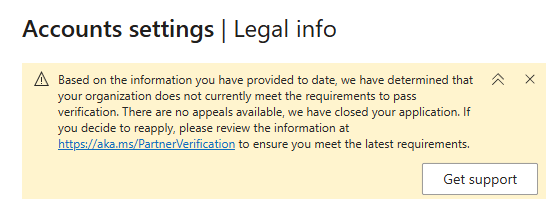
On the forum and in the email to 404 Media, Idrassi shared what he said was the only message he received connected to the account shutdown. “Based on the information you have provided to date, we have determined that your organization does not currently meet the requirements to pass verification. There are no appeals available, we have closed your application,” it reads.
Idrassi told 404 Media the message is concerning his company IDRIX. “As you can read in their message, they say that the organization (IDRIX) doesn’t meet their requirements, but I don’t see which requirement IDRIX suddenly stopped meeting,” he said.
The message Idrassi said he received.
Idrassi said he has tried contacting Microsoft support, but he received automated responses that he believes contained AI-generated text. “This is frustrating because they could at least explain what’s wrong,” Idrassi said.
“The lack of communication by Microsoft when they take such decisions adds uncertainty about the future, combined with automated AI feedback which gives an inhuman aspect to such decisions,” Idrassi said.
According to a post on Hacker News, the popular VPN client WireGuard is facing the same issue. “No warning at all, no notification. One day I sign in to publish an update, and yikes, account suspended,” Jason Donenfeld, the creator of WireGuard, wrote.
Microsoft acknowledged a request for comment but did not provide a response in time for publication.
For the last month Joseph and I have been playing as much Marathon as we can fit into our busy lives. During the pandemic, we bonded over playing Call of Duty: Warzone, and we’ve been chasing that high for years with little success. Bungie’s new extraction shooter finally gave it to us.
We should be happy, and we are as long as we’re focused on the game we’re playing and not the industry that’s collapsing around it. Marathon’s commercial success, measured by outsiders mostly by the number of people Steam shows is actively playing the game at any given moment, has no bearing on our enjoyment. But I can’t help but follow those numbers because they are a reminder of how brutal the video game industry is right now, where it might be headed, and how viable Marathon and games like it are in the future.
We don’t know how much Marathon cost to develop or what Sony Interactive Entertainment, which owns Bungie and is publishing the game, wants from it. The game has been a critical success, has reportedly sold 1.2 million copies, and players who have latched onto it like myself love how Bungie has been updating and balancing it after release. People are making horny fan art of Marathon characters.
At the same time, I watch the number of concurrent players on Steam, currently hovering at between 20,000 and 30,000, and fret. Is that enough for Sony to support Marathon for the long haul, and is it enough for the rest of the industry that’s watching this unfold to decide that the kind of player who enjoys a game like Marathon is still worth catering to?
Whether 20,000-30,000 concurrent players is a good number or not is relative and ultimately a decision only Sony can make. More than 19,000 games released on Steam in 2025 and only 6,000 of them earned more than $100,000. With at least tens of millions of dollars worth of sales on Steam alone, Marathon is one of the highest earning games on that platform. Marathon’s numbers are also considerably higher than Sony’s other big competitive shooter, Concord, which barely cracked 700 concurrent players on Steam before it was shuttered in 2024, barely a month after it was released. Highguard, another multiplayer shooter that was unveiled at the end of 2025’s Game Awards, also shuttered just a bit over a month after it launched. It peaked at almost 100,000 concurrent players on Steam, but it was free to play.
One might naively assume that the basic math at Sony would be to see how much Marathon cost to develop and maintain, see how much money it’s making after launch, and to keep the party going as long as it’s turning a profit. The reality is probably a bit more cynical and complicated than that. Bungie is a big studio that employees hundreds of developers that Sony acquired for $3.7 billion. One line item on Marathon’s budget that’s extremely hard to calculate is the opportunity cost of Bungie making Marathon as opposed to the next Fortnite, now that it’s becoming increasingly clear that Marathon will not be doing Fortnite numbers.
That doesn’t mean there isn’t a tremendously profitable business to be had there, given some patience and care. Ubisoft launched Rainbow Six Siege in 2015 to a tepid response, but has turned it into a decade-old cash cow with consistent support, updates, and a devious loot box-based monetization scheme. It essentially did the same thing for For Honor, a melee multiplayer game that I bet you forgot existed but that’s been going since 2017.
But Sony is a publicly traded company that wants to show quarter over quarter growth, and a modestly healthy profit that also happens to keep hundreds of game developers employed is not what shareholders are salivating over. Sony wants to do Fortnite numbers, which is a very tall order considering that even Fortnite isn’t doing Fortnite numbers anymore.
Our friends at Remap Radio have spoken at length about why discussions about player numbers teach us little about games and are often toxic. Part of the reason that games like Concord and Highguard can crash and burn so quickly is that the numbers become a self-fulfilling prophecy. There’s skepticism about the game before it launches, and when it fails to go viral, people write it off because why would they invest their time in an online game with player numbers that signal imminent and unceremonious execution by its financial backers, which only leads to even lower player numbers. It also shifts the conversation entirely away from what the game is, what people like about it, and why, and to its business model, infecting players with the quarterly earnings report view of the world. Games and players become expressions and subjects of business models, and the part where we play games because we enjoy them are reduced to a curious byproduct of Sony’s Earnings Before Interest, Taxes, Depreciation, and Amortization. Games from major publishers become either mega hits or are quickly slapped with the “dead game” label before they’re taken offline. What the game actually was is barely relevant.
Everyone I’m playing Marathon with is aware of the player numbers anxiety but is responding to it in different ways. Most of us are doing armchair video game industry analysis, while others are actively trying to enjoy Marathon’s popularity while we can precisely because it may be fleeting and eventually unavailable to play. Some of us are buying in-game cosmetic items not because we want them that bad, but as a signal to Sony that there’s money to be made here.
Adding to this player count anxiety is the fact that the video game industry appears to be going through what is increasingly looking like a proper crash. I don’t think we’ll ever have another near extinction event like the video game crash of 1983, where for a moment it didn’t seem like video games would even continue to be a thing, but a full one third of game developers in the U.S. were laid off last year, and the huge layoffs just keep on coming.
The question of whether Marathon is a viable business for Sony naturally leads us to the question: What business does Sony even want to be in going forward? Is it a business that’s in continuity with the games we grew up playing on the PlayStation and PlayStation 2, or will the market force it to chase something like Roblox or other free-to-play models? Can this continuity even exist when a PlayStation 5 Pro now costs $899 and a PlayStation 6 will cost more? Those are prices for 30 and 40 year-olds with disposable income, not the younger audiences game publishers need to be winning over now for their future business. Sony and other video game publishers are already losing them to different kinds of games and forms of entertainment.
“Marathon’s low gravity, bouncy physics, and methodical boot clunks echo Master Chief’s graceful, weighty gait circa 2004. It’s got modern conveniences like aim-down-sights, sprinting, sliding—and yet Marathon evokes a more civilized age,” Morgan Park wrote in his excellent review in PC Gamer. “Those qualities make it more accessible to a range of people who struggle to keep up in faster games while maintaining a skill range in other disciplines: timing, positioning, and perception. It’s fairly easy to track targets, but you’re still rewarded for nailing headshots, taking the high ground, and utilizing shell abilities. Does that make Marathon an unc game?”
To answer Park’s rhetorical question for him, yes, Marathon is in fact an unc game, which explains both why I like it so much and why I’m worried about its future. As you probably know, unc, short for uncle, is a way to jokingly refer to old, potentially out of touch people. As far as I can tell, it entered the video game discourse in the form of this meme in which a soyfaced unc excitedly points at the hall of fame of so-called “unc slop,” or, in other words, games that old people say are very good. Some of the games in this collage of video game box art includes Half-Life 2, Dawn of War, World of Warcraft, STALKER, Mass Effect, and Star Wars: Knights of the Old Republic. Or, many of my favorite games of all time.
Marathon could easily fit in that collage. It’s excellent, and, I worry, catering to a dwindling audience of uncs who are having a great time while the culture and business of video games is largely moving on and eventually leaving them behind.
It’s Trans Day of Visibility, and I’m at an event space in the heart of New York City’s Commie Corridor to learn how to become less visible online.
The crowd gathered at the aptly-named Trans Pecos in Ridgewood, Queens is here for “404: Deadname Not Found,” a digital self-defense workshop which promises to teach trans people how to find and remove their sensitive personal information from the internet (and which also has no relation to this website). The vibe is giving OpSec rave happy hour—attendees sip colorful drinks, groove to DJ sets, and huddle around laptops using online tools to track down their own digital footprints.
The goal of the exercise is to find holes in your digital defenses, a practice cybersecurity folks call “red-teaming.” A slide deck guides participants through this “self-doxing” ritual, instructing them to use websites like IntelBase, PimEyes, and haveibeenpwned to find addresses, selfies, passwords, old names and aliases, and other personal info that might have been left sitting around on the open internet.
It makes for great cocktail party banter. One participant raises their arms in triumph upon receiving a clean bill of health while checking if their information was leaked in a data breach. Others swivel laptop screens and compare notes on the various places their digital detritus had cropped up. In my case, I was lucky: I mostly found data brokers with incorrect information, a long-forgotten MySpace page, and a woman whose spam calls I’ve been receiving for the past 10 years. Finally, participants are directed to various pages where they can request data to be removed, or sign up for discounted services like Kanary and DeleteMe that do the removals on your behalf.
Behind the fun and light atmosphere, everyone here knows the unspoken reality that drives tonight’s activities: an unrelenting wave of discriminatory bills and executive orders that are rapidly demolishing trans rights across the US. “Trans Visibility” is a nice idea, but it turns out it really sucks to be visible in a fascist surveillance state where the highest levels of government are obsessively trying to destroy your ability to live.
“In this world of hyper-surveillance, I want to make sure all my stuff is safe and that no one is trying to harvest my data for anything,” Anna, a workshop participant, told 404 Media. Anna asked to use a pseudonym to protect her identity, which is not surprising given that the goal of the workshop is to make it harder to be doxed. “Especially now that there’s lots of incentives for the federal government to get into that business, I just wanna make sure all of that is under wraps.”
Like the event’s name suggests, many attendees are looking for traces of their “deadnames,” which is how some trans folks refer to the names they were given pre-transition. Trans people face a disproportionatelyhigh risk of being doxed online, and deadnames and other sensitive info are frequently dug up on right-wing hate forums like KiwiFarms and social media sites like Elon Musk’s X, where harassment campaigns and hate speech are allowed and even encouraged.
“We have to protect ourselves,” said Ryan, who also used a pseudonym. “It’s great to know how to find stuff like this, because you never know what’s still out there.”
Imani Thompson, a digital security trainer who organized the event as part of her series Cache Me Outside, says she started hosting the free workshops at queer bars in Brooklyn a year ago, after noticing trans and intersex friends who were noticeably shaken by the opening salvos of the second Trump administration.
“I hadn’t seen cybersecurity events that looked like they would attract or resonate with the crowds I felt needed this information the most,” she told 404 Media. “I wanted to make this fun and un-intimidating and doing digital security training at the bar is kind of silly and fun and gives us a built-in VPN and protection from sensitive convos being recorded.”
There are specific reasons many trans people are anxious about their personal data and online presence these days. For one, trans identities often don’t fit neatly into government boxes, and the name and gender they are assigned at birth may or may not match their government-issued IDs. Recently, a new law in Kansas resulted in hundreds of trans people being told that theirdrivers licenses and IDs had been invalidated overnight, forcing them to obtain new documents that revert to the sex marker assigned at birth. JournalistMarissa Kabas later reported that the 300 trans IDs in question had been flagged and not immediately invalidated, but the goal of the law and its ensuing chaos was clear: requiring trans people to have IDs that don’t match their appearance or lived reality, forcing them to out themselves and introducing friction and discrimination into their everyday lives.
The same Kansas law also implemented the first state-level “bathroom bounty,” making it a crime for trans people to use appropriate bathrooms and changing rooms and promising rewards to random passersby who feel “aggrieved” by someone they think might be trans. Lawmakers in Idaho have passed an even harsher bill, which would charge repeat trans bathroom-users with a felony and up to 5 years of jail time. These bills threaten not only trans people, but anyone whose appearance might fall outside of someone’s normative expectations of “male” and “female.” And they are especially dangerous at a time when facial recognition can near-instantly identify someone with a quick search.
Thompson also worries about the information that queer folks can reveal while asking for help online. Trans people experienceunemployment,housing insecurity, andviolence at exponentially higher rates than cis people, and it’s not uncommon to see Gofundme pages and Venmo accounts flooding social media feeds. These posts will sometimes include personal details like a person’s name, face, transition status, location, immigration status, and even how much they have in their bank account—great for getting donations, but not so great for the doxable breadcrumbs they leave behind.
“I think the risk is tenfold for the dolls and Black trans siblings because of disproportionate scrutiny in light of these bathroom bills and also how we do mutual aid,” said Thompson. “Whenever I see a mutual aid request being reposted or processed it makes me nervous, because we’re basically doxing our most vulnerable friends.” To reduce risk, she recommends people take down mutual aid posts as soon as needs are met and set their Venmo activity to private. “I feel like the intention in listing off how all these systems of oppression impact our friends are meant to create a sense of urgency and care, but then months later it’s still floating around and is a goldmine for someone who wants to claim they were made to feel unsafe in a bathroom so they can claim $3k or further an agenda.”
The privacy attitudes on display at the event contrast with the dominant media narratives about trans communities a decade ago. Fresh off the Supreme Court victory in Obergefell vs. Hodges that legalized same-sex marriage, many at that time were convinced that trans visibility would pave the way to equality, as glossy magazine covers featuring stars like Laverne Cox declared a “Trans Tipping Point.” But while conditions for some trans people marginally improved, we all know what happened next: a wave of reactionary anti-trans state laws, culminating in the re-election of Donald Trump and a series of executive orders aimed at destroying trans peoples’ access to healthcare, sports, bathrooms—essentially the ability to live a normal life.
At the same time, protection can’t be a retreat back into the closet. “It’s still important for trans voices to be heard in online spaces,” said Anna. “It’s not like I wanna go into the shadows or anything. I just don’t want people to know my personal data, my personal records, any of that.”
“Being Black, I also understand the distinction between visibility and hypervisibility and the precarity and lack of agency that hypervisibility creates,” said Thompson. “It’s tricky to find language around digital security that doesn’t imply queerness is something to hide or a shameful thing, because of course it’s not. I think having agency and purpose in how we can show up online and interact with tech as well as literacy around how technology and surveillance operates makes us better equipped.”
Janus Rose is New York City-based journalist, educator and artist whose work explores the impacts of A.I. and technology on activists and marginalized communities. Previously a senior editor at VICE, she has been published in digital and print outlets including e-Flux Journal, DAZED Magazine, The New Yorker, and Al Jazeera.
Discover OpenAI’s Child Safety Blueprint—a roadmap for building AI responsibly with safeguards, age-appropriate design, and collaboration to protect and empower young people online.
20 hours per week · Fully remote · $18 per hour + annual bonuses
The Role
You’ll be our first dedicated hire for the Korean market, responsible for both shaping our marketing strategy there and executing on it. That means understanding where our target audience (Korean students aged 16–24 who want to study abroad at English-medium universities) spends their time, and building a presence there.
Responsibilities
Develop and execute Arno’s Korean marketing strategy
Publish blog posts and educational content on Naver and other relevant platforms (Note: We are hiring a social media specialist, so you would focus on other platforms.)
Engage with potential customers in online communities (Naver Cafe, KakaoTalk, etc.), answering questions about English proficiency tests and Arno’s products
Build and manage relationships with Korean content creators, including affiliate/influencer partnerships and freelance content contributors
Requirements
Native Korean speaker with strong written communication skills in both Korean and English
Fluent in English, as you’ll regularly produce exam tips and educational content that requires a solid command of the language
Deep familiarity with the Korean study-abroad landscape
Strong knowledge of Korean digital marketing channels, including Naver Blog, Naver Cafe, and KakaoTalk
Self-directed and comfortable wearing many hats and working with a high degree of independence
Compensation
$18 USD/hour, 20 hours per week
Annual performance bonus based on individual contribution and company results
Payment via Wise in your currency of choice (converted from USD at the prevailing rate at time of payment)
Working style
This is a fully remote role, so you can work from anywhere. We’re a low-meeting team, so you’ll have significant flexibility over when and how you structure your hours. You’ll report directly to Otto, co-founder and CEO.