
Precision Talent

Loading

Governed agents are here. Is your stack ready?
Governed agents are here.  Is your stack ready?

Microsoft Build 2026 landed on June 2 in San Francisco with a message that AI decision-makers should take literally: the era of the AI agent as an unmanaged side project is over. The hobby bot has joined the org chart.

Chairman and Chief Executive Officer, Satya Nadella, declared from the keynote stage that “Windows doesn’t just run agents; Windows becomes the agent,” and behind that headline sat a governance stack deep enough to satisfy a compliance team, which is precisely the point.

The conference went beyond any single product. It unveiled a philosophy, codified into hardware, software, and pricing.


Why governance became the product

For the past two years, enterprise AI adoption has been throttled by a specific fear: 

  • A user deploys an agent
  • The agent has file system access
  • The audit trail is empty
  • Compliance inhales sharply

IT departments have been living in a world where shadow AI is real, and agent sprawl is accelerating. 

💡
According to a Deloitte 2026 report, only 21% of organizations globally have a mature governance model for autonomous AI agents. That is the gap Microsoft walked into at Build 2026.

Agent 365, generally available from May 1, 2026, at $15 per user per month, is Microsoft’s unified control plane for the agent fleet. Admins get a centralized registry showing every agent in the organization: which MCP servers it talks to, which identities are associated with it, and what cloud resources those identities can reach. 

For anyone who has tried to audit a fleet of Copilot Studio bots, this reads less like a feature announcement and more like a long-overdue apology.

5 questions to ask your AI agent vendor before you buy
Most AI agent failures don’t happen during the demo. They happen when APIs fail, context windows explode, costs spiral, and nobody can explain why the agent made a decision. Here are five questions that separate production-ready platforms from expensive experiments.
Governed agents are here.  Is your stack ready?

The stack Microsoft assembled

Build 2026 introduced several interlocking layers that, taken together, form what Microsoft is calling the Windows Agent Runtime:

  • Microsoft IQ unifies four intelligence feeds: Work IQ (Microsoft 365 signals covering emails, meetings, and org relationships), Fabric IQ (structured business data and semantic models), Foundry IQ (permission-aware knowledge bases for agent retrieval), and the newly announced Web IQ, which gives agents real-time external grounding. This is the context layer agents actually need to reason coherently rather than hallucinate confidently.
  • GitHub Copilot App ships as a standalone native desktop application on Windows, macOS, and Linux. Three operating modes (Interactive, Plan, and Autopilot) plus parallel sessions via git worktrees make this a meaningful step beyond autocomplete. Available immediately for Pro, Pro+, Business, and Enterprise tiers, with no waitlist.
  • Sandboxed execution containers give every agent its own hardened runtime, with IT admins applying governance policies through Intune and Group Policy tooling they already know. The developer reaction at Build was cautiously enthusiastic, particularly for the sandbox and containment boundaries as prerequisites for safely running agents with file access.
  • MAI models, Microsoft’s in-house model family, join Claude and next-generation OpenAI models as options within the Azure AI Foundry ecosystem. The multi-model diversification is deliberate. Lock-in anxiety is real among enterprise buyers, and Microsoft is reading the room.

Context mapping capabilities and runtime blocking via Intune and Defender are entering public preview in June 2026, so the governance story is still completing its rollout.


What the analyst picture says

The build announcement lands inside a market under genuine pressure. Gartner predicted in August 2025 that 40% of enterprise applications would embed task-specific AI agents by the end of 2026, up from less than 5% in 2025. The acceleration is real. 

The governance readiness is where the record scratches: Gartner’s 2026 Hype Cycle for Agentic AI places agentic AI governance, security, and FinOps for agentic AI as distributed concerns across the curve, noting that “the need for oversight and discipline is becoming evident early in the adoption cycle, not only after large-scale deployment.”

The failure forecast is worth naming plainly, before anyone orders matching agent-branded hoodies. Gartner expects more than 40% of agentic AI projects to be canceled by the end of 2027, with unclear business value and inadequate risk controls as the primary drivers.

Microsoft’s governance pitch at Build is, structurally, a bet on being the platform that survives that attrition.


The competitive read

Microsoft’s agent-native push arrives as Google expands Project Mariner across ChromeOS and Android, and Apple integrates a next-generation Siri agent into macOS and iOS. Neither competitor matches Microsoft’s enterprise footprint. 

Windows runs on over a billion machines, and Microsoft 365 is embedded in most corporate IT budgets before the AI conversation even begins.

The governance differentiation is also uniquely Microsoft’s to own. Google’s Vertex AI Agent Builder offers compliance features; Apple’s ecosystem brings data privacy credentials. Neither provides integration depth with Active Directory, Purview, and Microsoft Sentinel comparable to what Microsoft assembles natively. 

For regulated industries such as banking, healthcare, or insurance, that integration gap is what separates a proof of concept from a production rollout.

💡
Microsoft’s internal data, shared during the keynote, shows 67% of the Fortune 500 already using at least one Copilot feature. Agent capabilities have been the top enterprise request for 18 consecutive months.

The distribution advantage is already in place; Build 2026 is the moment Microsoft attempts to convert its installed base into a governed agent fleet.

How RLHF encodes bias through alignment tampering | AIAI
Your reward model is learning exactly what your annotators prefer. The problem is that “better” and “unbiased” are two different things, and RLHF has no way to tell them apart.
Governed agents are here.  Is your stack ready?

What decision-makers should do right now

The question for AI leaders goes beyond whether to evaluate the Microsoft agent stack. The more pressing question is whether your organization’s current data architecture can support what agents actually require. Here is the practical checklist:

  • Audit your agent surface now. Before Agent 365 registry sync with AWS Bedrock and Google Cloud connectors arrives (currently in public preview), understand what agents already exist in your environment, sanctioned or otherwise. Shadow AI is most dangerous when it has enterprise data access and a suspicious amount of confidence.
  • Map data readiness before agent readiness. Deloitte’s 2026 research identifies data quality as the biggest blocker for 52% of organizations. An agent with access to inconsistent or ungoverned data produces confident-sounding wrong answers at scale, which is a worse outcome than slow answers.
  • Separate agent governance from agent experimentation budgets. Agent 365 at $15 per user per month and the Microsoft 365 E7 Frontier Suite at $99 per user per month represent meaningful licensing decisions. Evaluate them against the cost of a governance failure and the cost of the pilot you ran last quarter, the one everyone now describes as “strategic learning.”
  • Pressure-test the orchestration story. Microsoft’s Agent Orchestrator service, entering preview in August 2026, handles load balancing and unified billing across large agent fleets. Build the architecture anticipating that service, rather than treating it as optional.

The line that matters

Every session at Build 2026 carried the same message: agents require governance before they belong in the enterprise. Microsoft has decided that the organization willing to build the governance layer first and then sell the agent capabilities on top owns the long game. 

The bet is plausible because the alternative, powerful agents with an absent control plane, is something enterprise IT has already lived through with shadow IT, and is deeply reluctant to repeat with systems that can take actions.

💡
The next six months will reveal whether the governance architecture holds under production load. The first wave of Agent Mode capabilities lands in Office 365 before the end of June 2026. Organizations that wait for reviews before deciding where to build will be watching others discover the rough edges. 

Early movers get to shape how those rough edges get smoothed.

Why smart companies don’t add AI everywhere
Boards want AI roadmaps. Competitors are shipping AI features. And 74% of companies still can’t make it pay. This piece breaks down the eight-point framework that separates disciplined AI adoption from expensive noise.
Governed agents are here.  Is your stack ready?

Final thoughts

Microsoft’s Build 2026 was a governance manifesto dressed in developer tooling, more so than a product announcement. For AI decision-makers, that is actually the more useful version of the keynote, because it tells you exactly what problem Microsoft thinks enterprises are trying to solve. 

If your organization agrees with that diagnosis (agents are real, control is missing, and the cost of ungoverned autonomy is rising), the Build 2026 stack deserves serious evaluation. If you think the governance layer can come later, Gartner’s 40% failure forecast would like a word, and it has brought receipts.

ICE’s Plan to Let Cops Around the Country Scan Faces to Verify Immigration Status

📄
This article was primarily reported using public records requests. We are making it available to all readers as a public service. FOIA reporting can be expensive, please consider subscribing to 404 Media to support this work. Or send us a one time donation via our tip jar here.

ICE’s Plan to Let Cops Around the Country Scan Faces to Verify Immigration Status

Immigration and Customs Enforcement (ICE) plans to give potentially more than a thousand local law enforcement agencies a facial recognition app that would query a database of hundreds of millions of images to verify someone’s immigration status, according to an internal Department of Homeland Security (DHS) document obtained by 404 Media.

The app would be a dramatic escalation in the technology being used to carry out the Trump administration’s mass deportation agenda. ICE and Customs and Border Protection (CBP) are already using Mobile Fortify, a facial recognition app that taps into a wide array of DHS and other government databases, on U.S. streets, stopping people and scanning their faces. With that app, ICE officers point their phone camera at a person, the app scans their face, and the app returns a wealth of biographical information and whether they have been issued an order of removal. The app has made mistakes and been used against American citizens.

With this second app, much of that capability would now be in the hands of local police who essentially have become extensions of ICE.

“This embarrassingly cursory document utterly fails to acknowledge the harms that will flow from putting a flawed face recognition app in the hands of many thousands of local police,” Nate Wessler, deputy director with the American Civil Liberties Union (ACLU) Speech, Privacy, and Technology Project, told 404 Media. “Sending local cops out to indiscriminately scan our faces, with a system that is known to generate false matches, that saves our data for 15 years, and that ensnares police into making immigration decisions that they are untrained for and that will undermine community safety efforts, is a recipe for disaster and for terrorizing members of communities across the country. DHS’s privacy regulators fell down on the job. Now it’s up to lawmakers to ensure this dangerous technology stays off our streets.”

💡
Do you know anything else about this app? Are you a current or former ICE or CBP employee? I would love to hear from you. Using a non-work device, you can message me securely on Signal at joseph.404 or send me an email at joseph@404media.co.

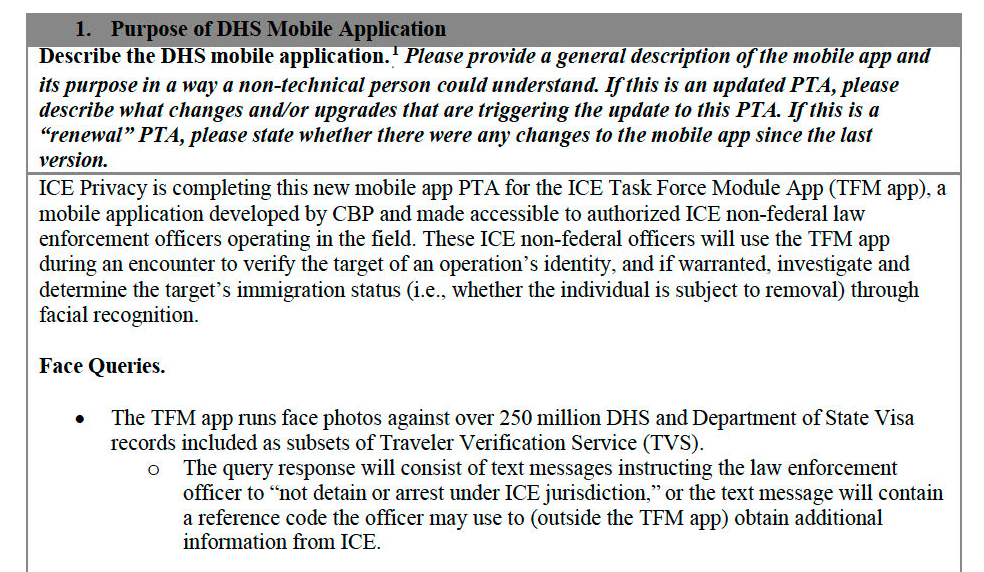
“These ICE non-federal officers will use the TFM [Task Force Module] app during an encounter to verify the target of an operation’s identity, and if warranted, investigate and determine the target’s immigration status (i.e., whether the individual is subject to removal) through facial recognition,” the document reads.

The name of the app is the “ICE Task Force Module App (TFM App),” according to the document. When an officer scans someone’s face, the app will run their face against a database of more than 250 million DHS and State Department records, and then provide instructions to the officer. Either “not detain or arrest under ICE jurisdiction,” or the app will provide a reference code the officer can use to get additional information from ICE.

ICE’s Plan to Let Cops Around the Country Scan Faces to Verify Immigration Status
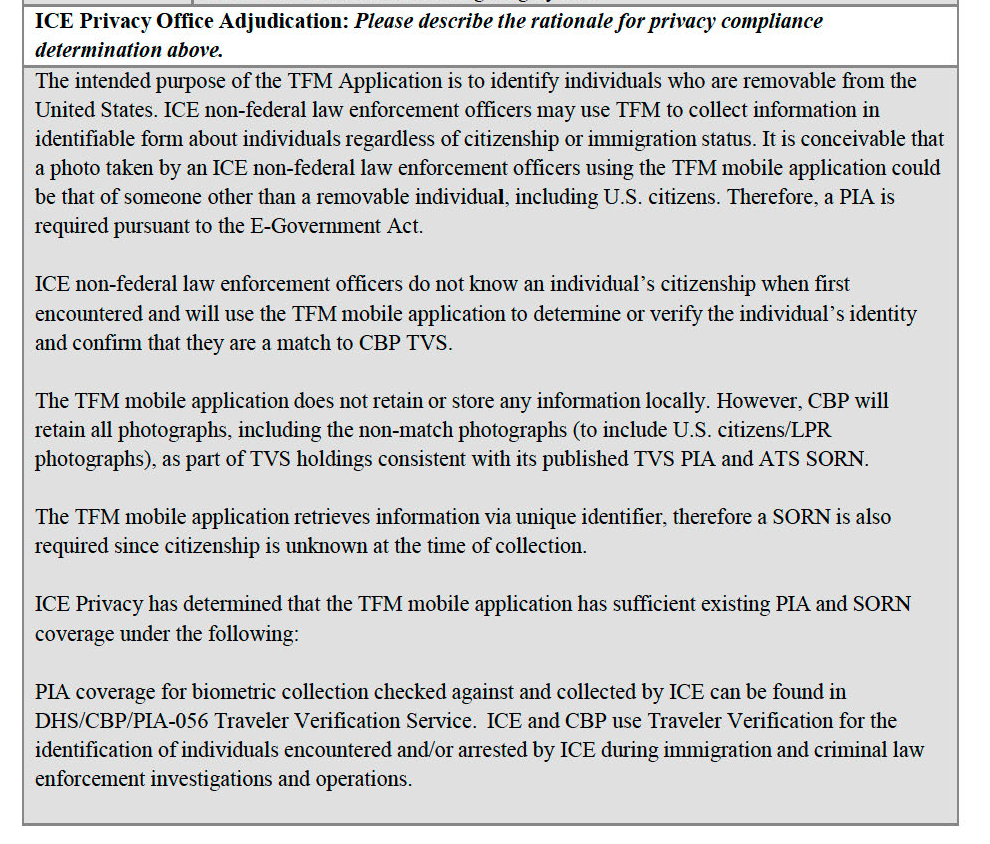
A screenshot of the document. Image: 404 Media.

404 Media previously reported the existence of Mobile Identify, which appears to be the same app under a different name, in November. It was removed a short while later from the Google Play Store and has not returned. The new document also mentions making the app available through the Apple App Store.

It is not clear when, or if, ICE or other DHS components will roll out the app to local police. DHS did not respond to a request for comment, and the document lists the launch date as September 24, 2025. But the new document describes in detail the plan behind giving this facial recognition app to local police. 

“The collection of face images allows ICE non-federal law enforcement officers to verify identity and immigration status (whether the individual is removable),” the document adds. ICE acknowledges in the document that the app may be used on U.S. citizens. “It is conceivable that a photo taken by an ICE non-federal law enforcement officers using the TFM mobile application could be that of someone other than a removable individual, including U.S. citizens,” it reads.

ICE’s Plan to Let Cops Around the Country Scan Faces to Verify Immigration Status
A screenshot of the document. Image: 404 Media.

“ICE non-federal law enforcement officers do not know an individual’s citizenship when first encountered and will use the TFM mobile application to determine or verify the individual’s identity and confirm that they are a match to CBP TVS,” it reads. TVS is the Traveler Verification Service, the CBP system usually used to verify people entering the country at ports of entry, but which ICE has now turned inwards onto American streets.

The app is designed for members of the 287(g) program, an ICE initiative that grants local and state police certain immigration enforcement powers. It “essentially turns police officers into ICE agents,” according to the New York Civil Liberties Union. More agencies have joined the program recently, including Texas’s Highway Patrol. At the time of writing, 1,220 agencies in 32 states and 2 U.S. territories participate in the program, according to ICE’s website

These are the agencies that would potentially be given access to the app, as the document points specifically to 287(g) as the legal basis of the app. 

“This document confirms our worst fears about the spread of ICE’s abusive surveillance technology. Face surveillance was already a dangerous infringement of civil liberties in the hands of ICE agents,” Cooper Quintin, security researcher and senior public interest technologist with the EFF, told 404 Media. “Putting it in the hands of ICE’s local partners will subject even more Americans to omnipresent surveillance and unjust detainment.”

After 404 Media revealed the existence of both Mobile Fortify and Mobile Identify, a group of six democratic lawmakers proposed legislation that would rein in the apps, and entirely kill the local enforcement version

404 Media obtained the document through a Freedom of Information Act (FOIA) request with CBP. 404 Media previously obtained a similar document from CBP for Mobile Fortify. That document said ICE believes people cannot refuse to be scanned by its app.

At a recent border security conference, Matthew Elliston, assistant director of Law Enforcement Systems & Analysis at ICE, said Mobile Fortify has been used more than 200,000 times, multiple attendees of the conference told 404 Media.

Based on comments from that conference and an DHS source, 404 Media reported that ICE plans to develop its own smartglasses to “supplement” its facial recognition app.

Update: this piece has been updated with comment from the EFF.

PATH to boost AI training and career opportunities for industry-aligned jobs

MIT, in collaboration with Georgia State University and a growing network of educational institutions, has announced expanded work under PATH (Pathways for AI Training and Hiring) — a multiyear initiative designed to scale effective, affordable, industry-aligned AI training for entry-level and current workers, with a particular focus on transforming community colleges into engines powering an AI-enabled workforce for the nation. 

“In the era of AI, economic opportunity and mobility will increasingly depend on whether people can develop practical, industry-relevant AI skill sets and mindsets, not just familiarity with tools,” says Cynthia Breazeal, principal investigator (PI) of PATH and professor of media arts and sciences at MIT. “That means combining hands-on, work-learn experiences with strong technical foundations and the responsible design, professional, and human skills that employers are looking for.”

To make that possible, the initiative is building state-based hubs anchored by research universities and community colleges. Each hub works with regional employers to design curricula that reflect local industry needs. The program also provides professional development for instructors and develops modular, open educational materials that institutions can adapt and share.

“Artificial intelligence is shaping every sector of the economy, and the United States will need far more people who understand how to build with these technologies and apply them responsibly,” says MIT President Sally Kornbluth. “Through PATH, MIT RAISE is using our convening power to bring community colleges, industry, research universities, and government together to build human-centered AI pathways that lead to shared prosperity. When research universities contribute their expertise to expand access and economic mobility, we strengthen both the nation’s workforce and our collective capacity for innovation.”

Unlike many large-scale online training efforts, PATH emphasizes in-person, collaborative learning. Students work in teams to address real problems brought by industry collaborators. These projects mirror the kinds of challenges graduates will face in the workplace, helping them build technical skills alongside the judgment, communication, collaboration, and ethical awareness that employers increasingly value.

The initiative’s first two hubs launched earlier this year in Massachusetts and Georgia.

“As PIs for the Georgia PATH hub, we are very excited with the significant early momentum, with over 1,000 GSU students enrolled in PATH courses,” says Arun Rai, regents’ professor, Howard S. Starks Distinguished Chair, and director of the Center for Digital Innovation at Georgia State University (GSU), with Balasubramaniam Ramesh, regents’ professor and the George E. Smith Eminent Scholar’s Chair at GSU. “Our curriculum, co-designed with MIT RAISE and spanning AI foundations, data science, deep learning, and agentic AI systems, is now being shared with partner institutions including Georgia Gwinnett College, GSU Perimeter College, and Clark Atlanta University. By leveraging the University System of Georgia’s FinTech Academy to expand work-based learning opportunities, we are building a collaborative ecosystem that rapidly advances the state’s AI workforce capabilities and creates tangible, job-ready skills for our diverse student population.” 

GSU President Brian Blake says, “Our collaboration with MIT reflects a shared commitment to strengthening the nation’s AI talent pipeline. Georgia State University brings a distinctive strength to this effort — the ability to prepare students from all backgrounds for AI-enabled careers at scale. By combining academic rigor with strong industry partnerships and work-based learning, we are translating advances in AI into practical skills and expanding access to opportunities in this transformative era.”

In Massachusetts, students at Quinsigamond Community College are participating in Data Science in Action, a course that introduces AI-enabled data analysis and engineering. The class includes a hands-on Action Lab, modeled after experiential learning programs at the MIT Sloan School of Management. David Birnbach, lecturer at MIT Sloan, leads the design framework for the PATH Action Labs. Working with industry partners, students tackle real data challenges while building portfolio projects and professional connections. 

Beyond individual courses, PATH is building clearer pathways for students to turn AI learning into real job opportunities. Through industry-informed micro-credentials and a shared set of workforce skills, students will gain practical abilities that employers are actually looking for, along with the human skills needed to succeed at work, like communication, problem-solving, and collaboration. 

The MIT skills taxonomy team, led by Katerina Bagiati in collaboration with Professor Tom Malone from the MIT Sloan Center for Collective Intelligence, is mapping the skills and roles emerging in AI across fields such as financial technology (fintech), information technology, and business operations, with plans to expand into areas such as health care, manufacturing, and creative media. The goal is to help students build skills that are relevant, recognized, and directly connected to growing career paths.

The initiative is supported by a grant to MIT from Google.org, which is helping MIT and its collaborators build a multi-state network for AI workforce development.

“MIT’s PATH initiative offers a blueprint for expanding opportunity in the age of AI,” says Shanika Hope, director of Google.org. “By connecting research universities, community colleges, and industry partners, it helps translate innovation into real jobs and sustainable career pathways.”

PATH is led by Breazeal, who has brought together a cross-MIT team with expertise in AI literacy, workforce pedagogy, educator professional development, open education, research, and the future of work. Breazeal is a professor and director of the MIT RAISE Initiative. Eric Klopfer, director of the STEP Lab and co-director of the MIT RAISE Initiative, serves as a co-PI on this award. The GSU leadership team includes PIs Arun Rai and Balasubramaniam Ramesh.

Satya Nadella ‘Not Sure’ Who Said Microsoft Wanted to Make Addictive AI, Is Looking for Guy Who Did This

Satya Nadella ‘Not Sure’ Who Said Microsoft Wanted to Make Addictive AI, Is Looking for Guy Who Did This

On Tuesday, we published an article about an internal Microsoft strategy document that explained the company wanted to “make people addicted” to its new AI assistant, Scout. Thursday, Microsoft CEO Satya Nadella told staff that he was “not sure what this document is or who is writing and leaking this nonsense,” according to a message obtained by The Information

The document we reported on was not some random document. As we wrote at the time, the strategy document was written by Microsoft executives Omar Shahine, Jakob Werner, and some sort of AI writing tool. This information is in our original article and is readily available to Nadella. We wrote: “The document seen by 404 Media lists Shahine and another executive, Jakob Werner, as its authors. The document itself, however, notes that it was ‘co-created turn-by-turn with AI. Human verified every sentence.’” 

Shahine is the leader of Microsoft’s Scout project, as he has written numerous times on his own blog, on his LinkedIn, and on Microsoft’s own announcement of the software. In attempting to distance himself from his own company’s executives and strategy documents, Nadella has revealed that he either does not know how to read or does not know what is happening with some of the company’s highest-profile products. 

Phase one of the company’s launch plan for Scout, which was previously called ClawPilot internally, was to “make people addicted. Continue shipping the standalone ClawPilot experience. Pilot the UX, grow the user base, and build the skill and tool ecosystem that makes people depend on it daily. This is already happening organically.”

In Nadella’s message to staff reported by The Information Thursday, he wrote “this is absolutely a non goal! If anything we are doing the exact opposite. We want to make sure AI empowers and adds real value to human endeavor and broad economic growth! We should make sure that our teams are clear about this. Not sure what this document is or who is writing and leaking this nonsense! They may want to go work elsewhere…..” Nadella then linked to an aggregation of our article published by Futurism.

As mentioned, the document was written by Shahine. Shahine is not some random Microsoft employee, he is the person who imagined, pitched, and brought Scout to fruition, as he has tirelessly documented over and over and over again in many, many LinkedIn posts and on his personal blog. His job title is “Corporate Vice President of Microsoft Scout,” and he is the person who announced the product on Microsoft’s official blog. His biography on Microsoft’s website is “Omar Shahine is a Corporate Vice President at Microsoft where he leads Microsoft Scout.” Again, Shahine’s name is listed as the author at the top of the document we reported on.

Nadella’s message and a statement given by Microsoft to The Information by a spokesperson  are instructive in showing in the ways that big tech deals with journalists who deign to write articles that the companies would rather not exist. A Microsoft spokesperson told The Information Scout is for “helping people accomplish tasks more effectively—not encouraging dependency. Our goal isn’t more screen time. It’s more time back.” Microsoft did not say this to us; Microsoft said nothing to us.

Before we published this article, as we do with almost every article that mentions any company, we reached out to Microsoft for comment. We specifically said that we were writing an article about the “make people addicted” language and asked for comment, context, and more information about that language. Microsoft did not answer our questions, ignored the fact that we asked about “addiction,” and simply sent us a link to its public announcement for Scout. The company then attacked our report internally and externally to another media outlet. 

If Nadella is Looking For the Guy Who Did This, maybe he should read the documents his own company produces, or ask the guy who made it.

NSF renews support for MIT-led AI and physics institute, expanding a new model for discovery

The MIT-led Institute for Artificial Intelligence and Fundamental Interactions (IAIFI) has received renewed support from the National Science Foundation (NSF) for an additional five years, increasing annual funding from $4 million to $4.98 million. The renewal marks a new phase for IAIFI, which has spent its first five years building a research model and an interdisciplinary community around a central premise: that AI can open new ways of doing physics, while physics can help mold better AI systems. 

Launched in 2020 as part of the National Artificial Intelligence Research Institutes program, IAIFI brings together researchers from MIT, along with Harvard, Northeastern, Tufts, and Boston universities. Its work has shown that machine learning can accelerate discovery in physics, while insights from physics can make AI systems more principled and interpretable.

“From the beginning, IAIFI has been built around a two-way street: AI enabling better physics, and physics enabling better AI,” says Jesse Thaler, IAIFI’s director and a professor of physics at MIT. “We have seen this virtuous cycle play out across multiple areas of physics and AI over the past five years. The exchange is producing not just new results, but genuinely new ways of doing science.”

Research across physics and AI

IAIFI’s research spans particle physics, nuclear physics, astrophysics, and foundational AI, with many advances emerging from collaborations across those areas.

In particle physics, IAIFI researchers have developed AI techniques to handle the immense data rates from the Large Hadron Collider in real-time, helping turn a firehose of collision data into actionable physics. In nuclear physics, IAIFI researchers are using AI-based generative methods to model the interactions of quarks and gluons in lattice quantum chromodynamics, creating new ways to study the structure of matter from first principles. In astrophysics, machine learning is being used to uncover new cosmic phenomena and improve the sensitivity of the MIT-led LIGO gravitational-wave experiment.

At the same time, ideas from physics are informing the development of new AI methods. IAIFI researchers are developing learning algorithms and new model architectures that embed physics knowledge and best practices — including symmetries, geometric structures, exactness guarantees, and statistical methodologies — directly into neural networks, producing systems that are more reliable, interpretable, and data-efficient.

“AI has begun to transform how physicists tackle some of the field’s most challenging problems,” says Mike Williams, interim director of IAIFI and a professor of physics at MIT. “More importantly, it is starting to expand the frontier of what problems we can realistically address, making it possible to pursue questions that were once completely beyond our reach.”

Training the next generation

A defining feature of IAIFI is its investment in people. The IAIFI Postdoctoral Fellows program supports early-career scientists pursuing research at the intersection of physics and AI, pairing each fellow with mentors in both domains and fostering collaboration across institutions.

Eight fellows have completed the program to date. Three have secured faculty positions; others have taken research roles at leading AI companies or joined startups, reflecting how broadly the skills cultivated at IAIFI translate.

“The IAIFI Fellowship shows what can happen when early-career scientists are given the freedom and support to work across traditional boundaries,” says Phiala Shanahan, IAIFI’s interim deputy director and a professor of physics at MIT. “Our fellows aren’t just contributing to physics or to AI separately — they are helping shape a growing field at the intersection.”

IAIFI’s annual PhD Summer School has become a focal point for the growing community of “centaur scientists” with expertise in both physics and AI. For the 2026 edition, the program received nearly 600 applications for roughly 100 in-person spots, with about 300 additional participants expected to join virtually. Previous participants have strongly recommended the school to their peers for its combination of lectures, hands-on tutorials, coding sprints, and networking events.

At MIT, IAIFI has helped shape new educational pathways, including an interdisciplinary PhD program in physics, statistics, and data science — a collaboration between the Department of Physics and the Statistics and Data Science Center — which has awarded 20 doctoral degrees since 2021. IAIFI members Phil Harris and Isaac Chuang have also developed a course on computational data science in physics, offered both on campus (Course 8.16) and as a free online course through MITx.

A growing community

Beyond its core research and training programs, IAIFI convenes researchers through its annual summer workshop, which will be held this year at the MIT Schwarzman College of Computing building. The institute also engages the broader public through collaborations with the MIT Museum, the Museum of Science in Boston, hackathons, and widely viewed online content exploring AI and physics.

“IAIFI shows what becomes possible when researchers in physics, computation, statistics, and data science organize around shared scientific questions,” says Nergis Mavalvala, dean of the MIT School of Science and the Curtis and Kathleen Marble Professor of Astrophysics. “That kind of sustained, cross-disciplinary collaboration is essential to the future of scientific discovery.”

IAIFI is hosted in the Laboratory of Nuclear Science at MIT, led by Director Jesse Thaler (currently on sabbatical), Interim Director Mike Williams, Interim Deputy Director Phiala Shanahan, and Managing Director Marisa LaFleur, along with steering committee members Lisa Barsotti, Isaac Chuang, Will Detmold, Bill Freeman, Phil Harris, Lina Necib, Tess Smidt, and Marin Soljacic (and steering committee members from other IAIFI universities). 

Looking ahead

As a member of the National Artificial Intelligence Research Institutes program, IAIFI is part of a nationwide effort to advance AI-driven discovery and innovation.

“The connections among the NSF AI Institutes have been as valuable as the work within them and continue to grow,” says Marisa LaFleur, IAIFI’s managing director. “We’re sharing management strategies and resources for training, community building, and collaboration that make the whole network stronger.”

For IAIFI, the renewed funding is an opportunity to push deeper into what the institute calls the “physics of AI” — using physical reasoning, physical challenges, and physical tools not just to apply AI, but to understand and improve it. That agenda, along with a growing community of researchers trained to work across disciplines, is what drives the institute’s next phase.

“The first phase of IAIFI established the model: interdisciplinary research, early-career talent, and a dynamic community, organized around the idea that AI and physics make each other stronger,” Thaler says. “Now we have the foundation — and the entrepreneurial spirit of our centaur scientists — to push that model into new territory and raise our ambitions.”

Watch These Judges Rip Into Lawyers For Citing Cases That Don’t Exist


Watch These Judges Rip Into Lawyers For Citing Cases That Don't Exist

In the last few years, we’ve heard case after case where attorneys used generative AI and were caught including fake citations, quotes, and other major errors in their filings. This generally plays out in dockets, where their opponents or judges spot them and, in the polite language of the courts, scold them for wasting everyone’s time and being a disgrace to the legal profession. Sometimes, this results in serious sanctions. But it’s always entertaining to read.

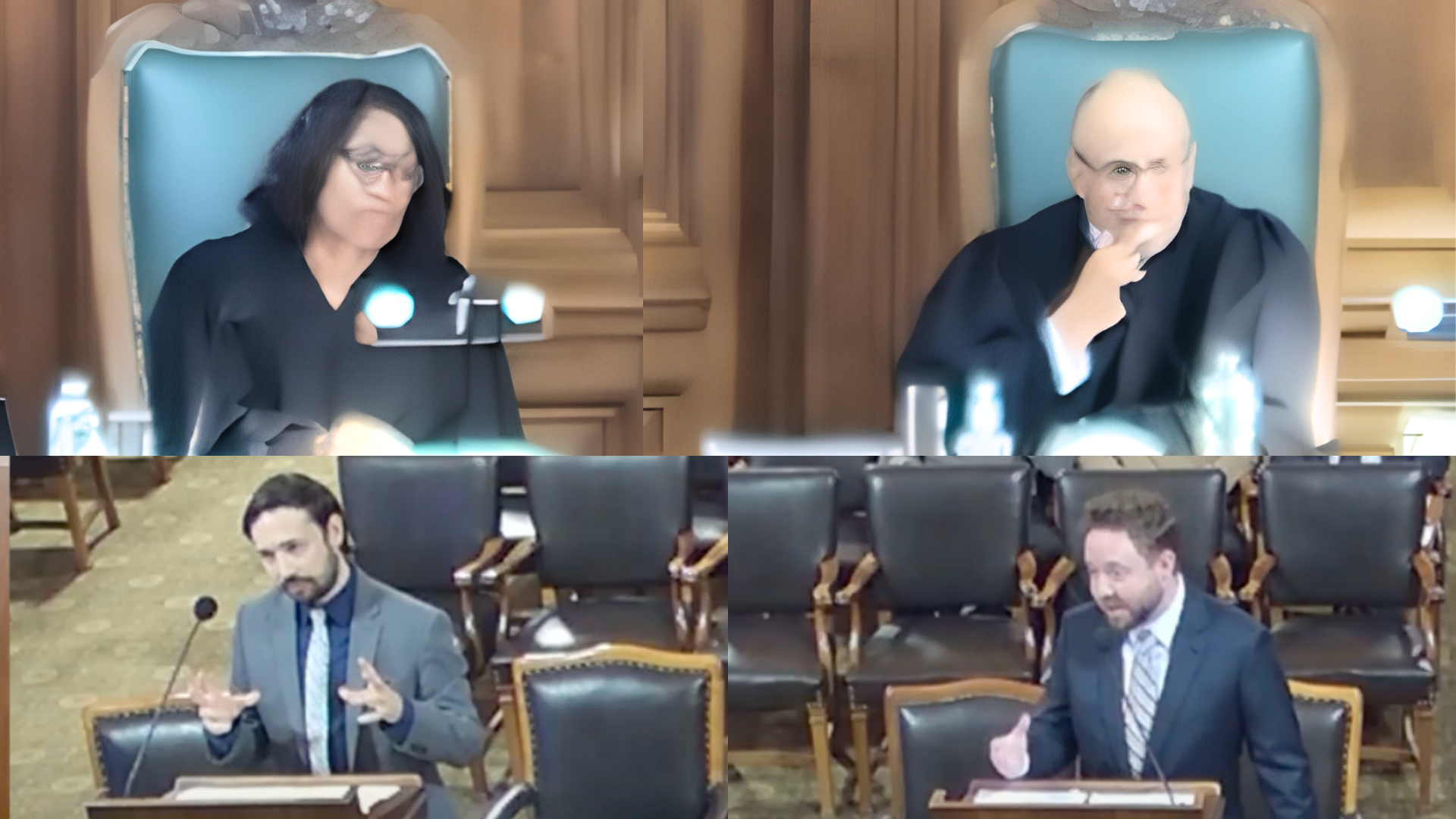
In an appeal hearing last month, a court’s live stream captured this happening on camera in real time, with an attorney caught for likely using AI-fabricated citations. On May 20, in the Supreme Court of the State of New York Appellate Division, Justices Valerie Brathwaite Nelson and Hector LaSalle reamed out that lawyer and his opposing counsel for more than 20 minutes, calling the situation “striking, concerning, disappointing, and saddening.”

The plaintiff in the case, Judith Landberg, is suing the city of New York after she tripped on some askew bricks on the sidewalk that were pushed up by tree roots. In that hearing, her lawyer, Michael Sanders, was attempting to argue the definition of a sidewalk. The full video is here, and the portion about fake citations begins a little after the 19 minute mark.

“In preparing for this oral argument and reviewing the brief of appellant, it came to the attention of the court that the brief submitted by plaintiffs cites at least three cases that appeared to be fictitious,” Nelson said. “None of these cases, nor the quoted language, appears to exist.” 

Not only did Sanders cite cases that don’t exist, Nelson said, he cited 10 other cases that appear to misrepresent the law. “How do you respond?” Nelson asked.


0:00

/2:48


Sanders instantly started digging a hole, saying that he wasn’t prepared to speak on those specific citations. Nelson promptly cut him off. “Before you go any further,” she said, “let me point out to you that Rule 3.3 A of the rules of professional conduct indicates that a lawyer shall not knowingly make a false statement of fact or law to a tribunal, or fail to correct a false statement of material fact or law previously made to the tribunal by the lawyer.”

He stammered. “If there’s any citations that are incorrect, my deepest apologies,” he said.

“Where did you get them from?” LaSalle asked.

“I don’t know what these cases were specifically,” Sanders said.

LaSalle and Nelson grilled Sanders for several more minutes about the citations and where he got them. The judges didn’t bring up generative AI specifically, but considering the growing epidemic of lawyers including fake citations while using AI to draft arguments and appeals, it’s almost certainly what they’re alluding to. Attorneys caught using AI in other cases have blamed everything from head colds to being in a rush, to paralegals. Judges, in general, seem sick of it.

“Just so you know, because I don’t want you to dig a bigger hole here, you’re citing principles that don’t exist,” LaSalle said. “Let me tell you something. We saw this last week. I was hopeful that, in preparation for today, that you were going to read this and say, ‘Oops, we made a mistake, Judge.’ It happens sometimes, right? That’s what I was hoping for. We didn’t get that. Should we give you some time right now to go look these cases up?” 


Sanders replied that it would probably take longer than 15 minutes. They went back and forth, with LaSalle and Nelson taking turns trying to impress upon Sanders that this is very, very bad.

Ross Friscia, the attorney representing the owner of the property that faces the sidewalk, stood up before the judges next. He started to speak, but LaSalle wasn’t finished with the dressing-down. “He’s raising a court of appeal standard that doesn’t exist,” LaSalle said, interrupting Friscia. “He was using it as a component of his argument, and you didn’t think you should bring it to our attention?”

“I didn’t notice in particular that the principle of law that he was citing was incorrect,” Friscia said. 

“I’m sorry, I’m going to give you every opportunity to make your argument,” LaSalle said. “But I’m befuddled. I honestly am. I’m absolutely—and I’m not here to—lawyers make mistakes. It’s not an easy profession. I don’t want to sit here beating up on lawyers, but we rely on the bar so much in what we do. So the first thing that I did, I don’t want to speak for my colleagues, but after seeing what he wrote, when I went to your papers, I expected to see something referencing […] It wasn’t one case, counsel, it was several cases, and you didn’t see fit to bring it to our attention either. It’s just striking to me.” 

Friscia, now with the fear of the bar in him, apologized profusely. “Your honor, I apologize to the court. I will do further due diligence going forward from this point on.”

“I hope so,” LaSalle said. “You should apologize to your client, not to me.”

“Yes, I apologize for that,” Friscia said. “And I will, going forward, check every single case, even if it stands for, you know, general principles of law, like the construed liberally to effectuate remedial purpose, and things like that. I will bring them to the court’s attention.”

At this, Nelson jumped in: “The misrepresentations here are of such a degree that they could not merely reflect a difference of opinion,” she said. “As an appellate court attorney, you would have to, if you were doing the work and reading the briefs and responding to the briefs, you would have to notice that something in the wording of the main brief for the appellant was wrong, if not many things being wrong. It’s concerning because we are all officers of the court, and there is a responsibility that you also have to notify the court to do the work, notify the court when these types of misrepresentations and fictitious cases and fictitious citations and misrepresenting the holding of a court of appeals case. I could go on and on, but if you read the brief and looked at the cases, you would have realized it was your responsibility also to alert the court.” 

Friscia said he tailors briefs to respond to specific issues but didn’t keep explaining himself for long; he apologized again, repeated that he’d be more thorough next time, made his point about the city being responsible for the askew bricks, and sat down.

Next up was Elizabeth Freedman, an attorney representing the City of New York. She got the same questioning from Nelson: “So, how do you explain your failure to bring to the attention of this court that a brief was filed with this court by appellant’s counsel with apparent fabrications and misrepresentations?”

Freedman tried to explain. “I certainly read the briefs,” she said. “I certainly read all of the briefs here, but I certainly didn’t focus on it, because it was not our issue. And I do apologize to the court for not catching that, but I tended to focus more on the issue of prior written notice.”

When Freedman finished, all of the attorneys stood up and attempted to leave quickly. “Don’t go anywhere yet,” LaSalle said. “Have a seat. I just want to say this to you all. This is a very distressing situation. I know this is an outlier. We’re very fortunate, my colleagues and I, we have the privilege of working with what I think is one of the best benches in the state, the bars in the state. For me the appellate bar here in the city of New York and its surrounding suburbs, we see excellent work. For me personally, it’s been a highlight of my career to have the opportunity to work with such outstanding judges, and to have the opportunity to work with such outstanding lawyers,” he said. “A part of this profession, a big component of it, is that there’s an element of trust, and mistakes are made. We make mistakes as judges, we’ve made mistakes. I don’t want to speak for my colleagues, but I dare say that we’ve all made mistakes as practitioners, and we work very hard when there are mistakes to try to give the benefit of doubt to those lawyers who practice before us. We know how difficult your respective jobs are. And in reviewing this, I know my colleagues and I have tried to give every benefit of the doubt to the lawyers before us.” 

He went on to say that the citing of false cases that don’t exist and quotes that have no support in the law is “well below the standard we expect from the bar.” He said it’s “striking, concerning, disappointing, and saddening to think that members of the bar would forward cases to a court that don’t exist, and to think that the lawyers on the other side of that didn’t read it for whatever reason, didn’t check it.” 

Sanders got up and tried to apologize again before leaving. “You’ll have an opportunity to apologize in a different way,” LaSalle said. “Why don’t you do your research and find out how that happened, though?” 

Sanders and his law firm were ordered to show cause as to why they shouldn’t be sanctioned. On Wednesday, Landberg’s case was dismissed.

Building compliant AI Agents: Preparing Enterprise teams for the EU AI Act


Building compliant AI Agents: Preparing Enterprise teams for the EU AI Act

Most enterprise teams are treating EU AI Act compliance like a legal checkbox.

It isn’t.

For teams actually deploying production agents the requirements reach deep into how you build, monitor, and govern every step of the agent lifecycle.

What’s at stake:

If you’re moving AI pilots to production, compliance can’t live only in policy documents.

The EU AI Act requires risk management, event logging, transparency, human oversight, continuous monitoring and post-market reporting.

In this webinar, you’ll discover:

  1. Which EU AI Act requirements apply to agentic systems (and why agents face a higher bar than traditional AI).
  2. How Act requirements map to the agent development lifecycle: build, test, deploy, monitor, evaluate, improve.
  3. How observability, tracing, evaluators, and human-in-the-loop review create the audit trail regulators expect.
  4. How AI leaders are balancing governance, cross-functional ownership, and compliance without slowing innovation.
  5. How LangSmith supports audit-ready workflows with annotation queues, alerting, deployment controls and evaluators.

Fireside chat: governance in the real world

We’ll go beyond theory with an enterprise AI leader or external governance expert sharing how their team is actually approaching EU AI Act readiness – from risk controls and cross-functional ownership to building a compliance culture that doesn’t slow teams down.