
Precision Talent

Loading

I Tried to Find the ‘Arousal Intelligence’ In An Animated, Augmented Reality Porn Star


I Tried to Find the ‘Arousal Intelligence’ In An Animated, Augmented Reality Porn Star

Sometimes people—especially those in the field of public relations doing a pray-and-spray campaign, but also small-time developers, the occasional delusional vibe-coder, and local dipshits—deliver messages to my inbox like a cat dropping a dead mouse on my doorstep. For the most part, I resist the bait: often, bad press is still press to these people, or I’m just too busy to really look at the pitch or try the product. 

This week, I’m coming back from a week of being entirely offline. I didn’t look at the news or my inboxes for seven straight days. I’m feeling properly healed, and also like I need to retraumatize myself back into the swing of things. Lucky me, on Monday morning, someone representing EnjoyMeNow emailed me about “a mobile website that places a photorealistic 3D character in your real room using augmented reality” using something called “Arousal Intelligence” and “real-time physics,” which streams “in a full engine from a global delivery network.” This press release, sent from “a globally focused media and entertainment holding company pioneering technology-driven innovation across digital platforms worldwide” called DCBG Group which represents EnjoyMeNow, was very thrilling to read as someone who appreciates the art of a good word salad. I dropped what I was doing (deleting hundreds of other emails) to try it out. 

Once on the EnjoyMeNow.com mobile site, after agreeing that you’re over 18, you’re asked to choose a “Pleasurette™,” a gender neutral term for a series of 3D characters and a trademark filed two weeks ago. These include five women wearing sex toy store package lingerie, and one dude, Adrian. 

“Every character—called a Pleasurette™—is a photorealistic digital human built from scratch with realistic skin shading, multi-pass rendered hair, and soft-body physics. No real performers are filmed, recorded, or motion-captured. The characters are created entirely in 3D software.” Presented without comment are the Pleasurettes™:

I Tried to Find the ‘Arousal Intelligence’ In An Animated, Augmented Reality Porn Star

I choose Adrian first because I’m always curious how AR and VR porn copes with the fact that hovering pecs and an immobile penis are difficult to make sexy in this format, real or not. A lot of porn made for a VR or AR experience is shot from the penile point of view: It’s just easier to strap a 180 degree HD camera to a man’s face and tell him to hold still while a female performer is free to writhe around on top than vice-versa. Knowing this, and also knowing that the market for AR/VR porn caters heavily toward men (save for a few beacons of light, such as director Anna Lee, who a few years ago said of the proliferation of male-gaze VR porn: “You’re making the same stereotypical porn you made with a fucking camcorder. It’s the same MILF bending over in the kitchen to bake cookies”), I still went in hopeful. After all, they pitched me

But it became clear almost immediately that Adrian is not playing for my team, so to speak, and getting the full EnjoyMeNow experience as intended requires equipment I don’t have. To get your chosen Pleasurette™ into your camera’s view, you have to hold your phone at an angle toward your crotch and stroke your penis. Helpfully, since I don’t have one of those, the app overlays a semi-transparent image of a penis at the bottom of the camera. It waits for you to put your hand in frame near the penis-guide to let the show begin. Moving my hand across the camera unlocks the start button. It’s not doing this to make sure you’re choked up on it before starting; It’s calibrating the position of the 3D model to your hand’s location and size, because that’s what controls its interactive aspects. 


Without getting too graphic in a blog that’s already pretty explicit so far, this is what I encountered: Adrian walks into view totally nude, leading with his 3D dick at a 90 degree angle, and says “look up, here I come.” Tearing my eyes away from this perfectly straight tree branch and pointing the phone camera up as commanded, with more than a little trepidation, I see the jiggliest pair of male titties I’ve ever seen on screen, nipples wobbling independently of the rest of him. “Stroke back and forth your big dick,” he says, grammatically confounding me on top of already freaking me out with a thousand yard stare. When I make a jerkoff motion in his general direction, he squats up and down like he’s teabagging me in Halo. Bizarrely, when I do this, his entire body shrinks, my hand now a monstrous size in comparison to his penis. No judgement, but he moans in a woman’s voice. “Come on my back soon,” he says, before a screen interrupts the session saying I need to pay $2.99 to unlock more features, such as making my Pleasurette™ orgasm. (For the record, I tried two payment methods to fork over this low low price, both rejected.) The experience is the same with the other characters, just in different skins: the female characters crawl around and squat over my ghost penis, and I use my imagination to jerk it off, which ends up looking like I’m fistbumping tiny 3D women in the vagina. Sometimes, I clip through their hollow bodies and can see straight up into their heads or down through their labia.


0:00

/1:26


EnjoyMeNow’s PR rep claims that this interactivity is a world first. “Existing AR adult content is pre-rendered video or static models you look at,” they told me. “EnjoyMeNow is interactive, where the character responds to your hand in real-time, placed in your actual room through your phone camera. And it runs entirely in the mobile browser. No app, no download, no account. That combination doesn’t exist anywhere else from our research over the past year of creating this.” 

Companies like SexLikeReal and Naughty America have been doing AR and VR content for years, often featuring real porn performers. But this hand-tracking thing EnjoyMeNow is doing is different than that, they claim. And I’ll concede, yes, moving your hand up and down definitely makes the 3D model move around a little bit. Here’s how one of the femme characters acts:


0:00

/1:29


What really makes EnjoyMeNow stand apart from plenty of other AR porn products is this insistence that not employing real models or performers makes it better or smarter, somehow. On Monday, the DCBC Group’s website said of the choice to use CGI instead of people: “This was a founding decision, not a technical workaround. The adult entertainment industry has always relied on real people putting their bodies in front of a camera—and that comes with real consequences. Exploitation, coercion, content leaked without consent, performers pressured into work they’re uncomfortable with, and careers that follow people for the rest of their lives whether they want them to or not. We chose to build a platform where none of that is possible. Every character on EnjoyMeNow is created entirely in software. No one is filmed. No one is exploited. No one’s livelihood depends on what they’re willing to do on camera. The experience is just as immersive—and no real person is harmed or compromised in the process.”

The idea that the adult industry—and “putting bodies in front of a camera”—is inherently exploitative is not only false, it’s a harmful thing to say, and it’s especially galling coming from a literal porn web toy. This entire statement is so infuriating it’s hard to know where to begin with it. These are talking points used by the most conservative, anti-porn lobbying groups and politicians on the planet to justify stripping us all of rights, here being floated by an app that makes weird, schlocky and unsatisfying 3D characters that the residents in Second Life’s least-attended sex clubs wouldn’t even find sexy.

But again, because I had the time and was feeling fresh, I asked DCBC Group to defend this statement with some data at least. “We’re not making a judgment about the adult industry or its performers,” they said. “We built a product around CGI characters, that’s a format choice, not a moral position. Some people prefer content that doesn’t involve real people. We built for them. We’ve now updated our press page to better reflect that; thank you Sam for that observation.” The page now says “EnjoyMeNow is built around computer-generated characters rather than real performers. This is a format choice—offering a new kind of private, interactive experience that doesn’t exist in traditional adult content.” Good for them for changing it.

And since users are being asked to position their dongs in front of their phone cameras on a browser-based app, I took a look at the “privacy” section of the FAQ. “Privacy is architectural, not a policy bolt-on. No app is installed. No account is required,” DCBC wrote. “All camera and motion processing runs locally on the phone—no frames, no images, no data ever leave the device. There is no cloud processing, no recording, and no persistent data stored after the session ends. When you close the tab, the adult content is automatically purged from the browser.” 

I asked DCBC’s rep if they could elaborate. Well, they could at least throw more words at it: “Regarding content encryption, every 3D asset is individually encrypted at the file level, stored encrypted, transmitted encrypted, and only decrypted at render time using per-session keys that never touch the device,” they said. “There are no downloadable model files. This is a custom content protection system built specifically to prevent our CGI assets from being extracted, redistributed or changed. The specifics are proprietary, but it goes well beyond transport-layer encryption. One core goal of this architecture is ensuring no one can upload their own content to the platform. This is a closed system by design.” 

“Just needless words really,” 404 Media’s privacy and security reporter Joseph Cox said about this when I showed him what DCBC said. It could easily be cut down to “we don’t allow uploads.” Which is, to be clear, for the best.

I should say here that I don’t go into these sorts of reviews assuming that I am the target audience. I’m pitched regularly by porn sites and sex toy companies on products that aren’t my personal thing; I wrote a column for years about kinks and fetishes that are not many people’s thing at all, but I wanted to better understand them and what appeal they hold for the people who love them. Maybe there are people out there who simply cannot consume content with real people in it; if that’s you, please hit me up, I would really like to hear more about that.


Scientists Create Plant That Produces Ayahuasca, Shrooms, and Toad Psychedelics All At Once

🌘
Subscribe to 404 Media to get The Abstract, our newsletter about the most exciting and mind-boggling science news and studies of the week.

Scientists Create Plant That Produces Ayahuasca, Shrooms, and Toad Psychedelics All At Once

Scientists have engineered tobacco plants to produce five psychedelic compounds that are normally found in a wide range of natural sources, including psilocybin mushrooms, ayahuasca, and toads, according to a study published on Wednesday in Science Advances.

The breakthrough could lead to more sustainable and scalable production of these compounds by using model plants to biosynthesize common psychedelic “tryptamines,” such as psilocybin from hallucinogenic mushrooms, N,N-Dimethyltryptamine (DMT) from plants, and psychoactive compounds secreted by the Sonoran Desert toad. 

Eventually, this research could pave the way toward—as one example—tomato plants that contain microdoses of psychedelic cocktails in each fruit. However, the study’s authors emphasized that these modified plants would need to be limited to medical use in clinical settings, and should not be accessible to consumers for recreation.

“We are interested in this, not because of the recreational effects, but because of the medicinal potential,” said Paula Berman, a postdoctoral researcher at the Weizmann Institute of Science who co-led the study, in a call with 404 Media. 

“This combination of five psychedelics—I don’t think anyone has ever tried something like it,” added senior author Asaph Aharoni, principal investigator and head of the department of plant and environmental sciences at the Weizmann Institute of Science, in the same call.

Tryptamines are a subclass of metabolites—compounds produced by metabolic processes in organisms—which have wide-ranging potential as treatments for conditions such as depression, anxiety, mood disorders, and post-traumatic stress disorder.   

Indigenous cultures in many regions have cultivated tryptamines for thousands of years for ritual, spiritual, and therapeutic purposes. These compounds are now in high demand as both recreational drugs and medicinal treatments, though legal regulations governing their use vary widely around the world. 

Due to their growing popularity, many of the source organisms that produce these compounds are facing significant ecological stresses in the wild; for example, the Sonoran Desert toad population is rapidly declining due to poaching and over-harvesting. Scientists have produced synthetic versions of some tryptamines, but those methods often involve complicated processing steps and hazardous reactants that generate chemical waste.

To help alleviate these problems, Berman, Aharoni, and their colleagues reconstructed the biosynthetic pathways in five tryptamines: Psilocin and psilocybin, both found in hallucinogenic mushrooms; DMT, which is the psychoactive part of ayahuasca; and the psychedelic compounds bufotenin and 5-methoxy-DMT secreted by the Sonoran Desert toad. 

The team then inserted the active genes of these pathways into the leaves of a tobacco plant, creating a botanical platform to produce all five psychedelics. By design, the modified plants are not able to pass these genes onto future generations, as this study is intended to offer a “proof of concept,” Berman said. 

“In one leaf, we get five different psychedelics from three different kingdoms,” said Aharoni. “But since it is not inherited, it will stay in the leaves and will not go through to seeds, flowering, pollination, and to the next generation.”

“One reason that we did that is we are still not sure if we want to make plants where everybody can grab seeds from us and grow a plant with five different compounds” that might be deadly, he added. “We have to make sure that it stays in research.”

With that caveat, the team hopes that their work could lead to a method of tryptamine biosynthesis that could help meet the global demand for these compounds. In addition to sidestepping the disadvantages of synthetic versions, this technique could also remove stressors on wild populations. The goal is to ensure that wild tryptamine sources can be reserved for use in traditional Indigenous practices. 

The researchers are also interested in clarifying the evolutionary purpose of psychedelic compounds for the plants that naturally produce them, which remains mysterious in many cases.

“We understand the importance of the plants, the fungi, and the Sonoran Desert toad, and every species that we discuss in the paper,” Berman said. “One of our motivations was to really understand better what these species do, so that we can mimic what they do.”

“Over-harvesting endangers the natural availability of these species for native peoples and Indigenous groups,” she concluded. “We have so much respect for the knowledge that they provide us, and we just want to add to this knowledge and to be able to produce these in a more sustainable way.”

🌘
Subscribe to 404 Media to get The Abstract, our newsletter about the most exciting and mind-boggling science news and studies of the week.

A Secure Chat App’s Encryption Is So Bad It Is ‘Meaningless’


A Secure Chat App’s Encryption Is So Bad It Is ‘Meaningless’

TeleGuard, an app that markets itself as a secure, end-to-end encrypted messaging platform which has been downloaded more than a million times, implements its encryption so poorly that an attacker can trivially access a user’s private key and decrypt their messages, multiple security researchers told 404 Media. TeleGuard also uploads users’ private keys to a company server, meaning TeleGuard itself could decrypt its users’ messages, and the key can also at least partially be derived from simply intercepting a user’s traffic, the researchers found.

The news highlights something of the wild west of encrypted messaging apps, where not all are created equal.

“No storage of data. Highly encrypted. Swiss made,” the website for TeleGuard reads. The site also says, “The chats as well as voice and video calls are end-to-end encrypted.”

💡
Do you know anything else about this app or other security issues? I would love to hear from you. Using a non-work device, you can message me securely on Signal at joseph.404 or send me an email at joseph@404media.co.

In March an anonymous security researcher, who didn’t provide their name, told 404 Media about a series of vulnerabilities in TeleGuard. They included the fact the TeleGuard app uploads users’ private encryption keys to the company’s server upon account registration. 

Often when implementing encrypted messages, apps will assign users a public and private key. The public key is what other users use to encrypt messages for them, and the private key is what a user uses to decrypt messages meant for them. If this key falls into someone else’s hands, they may be able to read a users’ messages.

In true end-to-end encryption, this encryption happens on a user’s phone, and the key should never leave that device. With TeleGuard, the app is transmitting that highly sensitive key to the company’s servers. Technically, the app uploads an encrypted version of the private key, but it also transmits other information that allows the server to decrypt it, the researcher explained. That includes the user’s unique ID, which is also uploaded along with the key; a hardcoded salt (which in cryptography is supposed to be a random string of characters, but in this case is constant); and a hardcoded nonce (which is also supposed to be random for every communication to stop certain attacks, but is constant with TeleGuard). “The server can decrypt every user’s private key. It has everything,” the researcher wrote in their findings shared with 404 Media.


That series of design decisions means TeleGuard, the company, receives users’ private keys. But the keys are also accessible to other attackers. The researcher found it’s possible to retrieve a specific user’s private key by simply plugging their user ID into TeleGuard’s API. Many people share their user ID publicly so they can be contacted, opening them up to this attack.

404 Media asked Dan Guido, CEO and co-founder of cybersecurity firm Trail of Bits, whether his team was able to verify the findings. Guido said the company found much the same thing, and added the app’s encryption “is meaningless,” because of the app uploading the private keys and the server’s ability to decrypt them.

Trail of Bits then found multiple other security issues with TeleGuard, including being able to at least partially extract users’ private keys from simply intercepting their traffic. Trail of Bits said it then successfully decrypted one of the shoddily encrypted private keys from that capture.

Guido sent 404 Media this meme: 

A Secure Chat App’s Encryption Is So Bad It Is ‘Meaningless’
Image: meme via Trail of Bits.

The researcher who initially reached out also said TeleGuard’s metadata—when someone sent a message, and to whom—is in plaintext, meaning that could be exposed to attackers too.

TeleGuard launched in around 2021, according to archives of the app’s page on the Wayback Machine. It is made by Swisscows, a company that also makes what it describes as an anonymous search engine, a VPN, and an email service. In a promotional video, TeleGuard claims to have “one of the strongest encryptions available.”

Neither TeleGuard nor Swisscows responded to multiple requests for comment, nor gave any indication or timeline of when they might fix the issues. 

TeleGuard has been recommended to cam models as a way to communicate, according to a post on a  subreddit for models. The app has also repeatedly been linked to child abusers, with one local media outlet reporting TeleGuard is “notorious” among prosecutors for child sexual abuse material. The FBI previously obtained data about a TeleGuard user through push notifications sent to their phone. A foreign law enforcement agency had TeleGuard hand over push notification-related data, which the FBI then took to Google to obtain email addresses linked to that alleged pedophile, The Washington Post reported.

Artemis II Astronauts Have ‘Two Microsoft Outlooks’ and Neither Work


Artemis II Astronauts Have ‘Two Microsoft Outlooks’ and Neither Work

In 1969, the three astronauts of the Apollo 10 mission conducted a momentous “dress rehearsal” for putting humans on the lunar surface for the first time. It was a historic, inspiring moment for humanity; Astronaut John Young watched from a command module spacecraft as Thomas Stafford and Gene Cernan broke away and flew a lunar module within 10 miles of the moon’s surface, then reunited to return home to Earth. It’s from this mission that we have one of the most powerful transcripts in NASA history: 

“Who did what?” Young asked. “Where did that come from?” Cernan added.

“Give me a napkin quick,” Stafford said. “There’s a turd floating through the air.”

The provenance of the poop remains one of the great mysteries of spaceflight. Today, in the early Earth-morning hours of the Artemis II astronauts’ history-mirroring mission around the moon, we have another: Why is Microsoft Outlook not working in space? 

On April 1, four astronauts from the U.S. and Canada embarked on a 10-day flight to loop around the moon. Spotted by VGBees podcast host Niki Grayson on the NASA livestream of live views from the , around 2 a.m. ET, Kennedy Space Center mission control acknowledges an issue with a process control system and offers to remote in—yes, like how your office IT guy would pause his CoD campaign to log into Okta for you because you used the wrong password too many times.

One of the astronauts, Reid Wiseman, says that’s chill, but while they’re in there: “I also see that I have two Microsoft Outlooks, and neither one of those are working.” 

right now the astronauts are calling houston because the computer on the spaceship is running two instances of microsoft outlook and they can’t figure out why. nasa is about to remote into the computer

niki grayson (@nikigrayson.com) 2026-04-02T06:06:53.835Z

Astronauts are trained for decades in some of the most physically and mentally grueling environments of any career. They’re some of the smartest people on the planet, and they have to be, before we strap them to 3.2 million pounds of jet fuel and make them do complex experiments and high-stakes decisions for days on end. And yet, once they get up there, fucking Outlook is borked. 

I scanned through the next several minutes after this moment and didn’t hear them address the duplicate Outlooks again. So, I emailed the Artemis II communications team, who is definitely not busy today I’m sure, and asked: Can the astronauts check their email yet?

I’ll update if I hear back.

Apple Gives FBI a User’s Real Name Hidden Behind ’Hide My Email’ Feature


Apple Gives FBI a User’s Real Name Hidden Behind ’Hide My Email’ Feature

This article was produced in collaboration with Court Watch, an independent outlet that unearths overlooked court records. Subscribe to them here.

Apple provided the FBI with the real iCloud email address hidden behind Apple’s ‘Hide My Email’ feature, which lets paying iCloud+ users generate anonymous email addresses, according to a recently filed court record.

The move isn’t surprising but still provides uncommon insight into what data is available to authorities regarding the Apple feature. The data was turned over during an investigation into a man who allegedly sent a threatening email to ​​Alexis Wilkins, the girlfriend of FBI director Kash Patel.

Iran Is Winning the AI Slop Propaganda War


Iran Is Winning the AI Slop Propaganda War

An AI-generated LEGO movie out of Iran depicting Trump as a war hungry pedophile has gone viral online. The video is the work of Iran-based propagandists called the “Explosive News Team” and is just the latest in a long line of AI-generated LEGO videos aimed at mocking Trump and Benjamin Netanyahu. LEGO-themed propaganda isn’t new and the Iranian video plays on familiar wartime propaganda themes. What’s different in 2026 is speed and scale.

During World War II, the Korean War, and the Vietnam War, America’s enemies littered the battlefield with pamphlets, cartoons, and radio broadcasts aimed at shaking the morale of American troops, but that stuff rarely got back home. Now, Iran can use AI tools to produce lavishly animated cartoons at scale for dissemination across social media all aimed at the US homefront.


The latest “Explosive News Team” video is set to a catchy rap song about how Trump is a LOSER and millions of people are watching it across multiple platforms. At the same time Iran is releasing AI-generated videos of Trump drowning in a river of blood, the US Department of Homeland Security is sharing fashwave filtered pictures of Gen Z ICE agents milling around airports.

Iran’s use of LEGO set rap music tells me it’s been studying us. These are videos meant for the American people crafted in a language Iran knows we’ll understand. 

Meanwhile, the White House is dropping Grand Theft Auto and Call of Duty memes that were out of fashion 10 years ago on Reddit and vague-posting pixelated images of Trump like it’s running an ARG. Iran is attempting to speak to the broader American public. Trump is confident he only has to impress the online freaks he thinks still love him.

In other words, there’s a AI slopaganda proxy war playing out, and Trump is speaking only to people whose brains are rotting out of their skull, while Iranian  propaganda is currently doing a better job of speaking to the concerns of the broad American population than the American president. Trump continues to narrowcast to his base while losing support for his wildly unpopular war as Americans worry about skyrocketing gas prices, a tanking economy and stock market, insane lines at airports, and a war that has little rationale and apparently no real goal. A recent Pew poll found 61 percent of Americans disapprove of Trump’s handling of the conflict. 

To be clear, it speaks to how bad things are online that we need to analyze whose AI disinformation and propaganda is “better,” and, in general, the slopification of the internet has been a disaster. And yet, the stuff Iran is making is resonating and spreading online in a way that Trump’s slop is not. We do not know who, specifically, is making the Iranian AI slop or which tools they are using to make it. But the fact that Iranian AI slop is resonating with Americans while American slop is not should perhaps not be surprising; for the last several years, the most successful purveyors of AI slop have largely been based in foreign countries, where they have been incentivized to make content that specifically targets American audiences because of the way that social media ad rates work. Because of that, an entire economy has emerged in which people who would otherwise have little interest in reaching American audiences have been incentivized to study what resonates with Americans on the internet and have created entire businesses focused on teaching other people what Americans care about and how to target them with AI slop.  


Propaganda, especially war-time propaganda, is about causing a quick emotional reaction in the viewer. Iran has proved remarkably capable of that and hits similar themes in most of its videos: Epstein, Netanyahu, and blood. “The really striking throughline is the 1) connecting victims from Minab to Epstein, 2) a cartoonish antisemitism that attributes the bog-standard reactionary hawkishness of Trump and Netanyahu to a sinister and supernatural evil, 3) heavy emphasis on missiles and revenge-weapons,” Kelsey Atherton, Chief Editor at Center for International Policy, told 404 Media.

“There’s a grand tradition of wartime propaganda aimed at convincing the other side to quit and I think Iran’s best falls into that camp, like North Korea and especially North Vietnam sending pamphlets aimed at getting black soldiers to defect by highlighting inequity at home,” Atherton said. “Iran’s online propaganda is trying to activate this by (charitably) appealing to class war and (uncharitably) leaning on antisemitism to get US soldiers to quit and to erode support among Americans watching short-form vertical video.”

In one AI-generated video shared by Russian state controlled news organization RT depicts victims of American military campaigns staring at the sky. It begins with an American Indian then cuts to a boy in Hiroshima, a schoolgirl in Minab, a little girl in front of the bizarre temple on Epstein’s Island, and ends with US-assassinated Quds Forces leader Qasem Soleimani.

US Under Secretary of State Sarah B Rogers attempted to critique the video in a post on X. “You do see common propaganda threads here and elsewhere: the ideology is resentment-driven, civilization-skeptical, and obsessed with upending, cathartic violence enacted by the ‘historically downtrodden’ (ie ‘wretched of the earth’),” she said

The post felt like projection and was especially strange given the Trump administration’s own resentment driven ideology, destruction of institutions, and obsession with revenge-driven violence on behalf of the “forgotten man.” Iran did not start America’s war with it. And it did not start the AI-generated propaganda war, it’s just doing it better than the United States.

There are other echoes of the past. An AI-generated Iranian riff on Pixar’s Inside Out shared on X by Iran’s embassy in the Hague showed a Disneyesque version of the inside of Trump’s brain. It showed frothing demons demanding the President lie to the press. A poster from World War II depicts an X-Ray photo of Hitler’s Brain filled with skeletons and snakes. It’s the same theme in different eras using different tools.

LEGO bricks, too, are a far older propaganda tool than the current war. The Danish bricks are one of the most recognizable toys on the planet. Last year, Russian propagandists circulated images of fake LEGO sets depicting soldier’s funerals ahead of an election in Moldova. In 2020, the Chinese released “Once Upon a Virus,” a LEGO short film that mocked America’s response to the Covid pandemic.

The Trump administration’s new fascist aesthetic is defined by AI slop. From Studio Ghibli-inspired grotesques to AI-generated Sora videos of ICE raids that never happened going viral on Facebook, Trump and his supporters are also using the tools of the moment to churn out crappy propaganda. The difference is that Trump’s videos aren’t about winning hearts and minds, they’re about activating a rapidly diminishing base of supporters.

“I think Trump’s stuff is aimed at the same audience, except to convince them that what they’re doing is righteous and good,” Atherton said. “Obviously we’re seeing the stuff put out in English to English video-watching audiences but White House videos—AI or otherwise—are like group-chat in-jokes aimed at keeping cohesion. It’s not an AI video but the Wii Sports/snuff film one is so skin-crawling that it requires the audience to be cooked in the feverswamps.”

The Trump administration has bet big on video game memes as the vehicle for its propaganda efforts. Last October DHS depicted Halo’s Master Chief as an anti-immigrant killer and compared immigrants to a ravening horde of mindless monsters. Two weeks ago it published a now-deleted video that mixed footage from Call of Duty with missile strikes in Iran. White House Communications Director Steven Cheung posted the infinite ammo cheatcode for Grand Theft Auto: San Andreas above footage of airstrikes.

Video games are incredibly popular in the United States, but many of these memes require a level of familiarity with specific games and the culture around them. LEGO, by contrast, is instantly recognizable to most of the world.

On March 5, the White House’s X account posted a video mixing American pop culture figures like Walter White, Optimus Prime, Super Man, and Tony Stark with footage from the war. Watching it, I was reminded of a moment from six years ago after America assassinated Soleimani during the first Trump administration.

On an Iranian television show, Cleric Shahab Moradi called in to share his thoughts on how Iran could strike back. Who might Iran attack that has the same cultural purchase as Soleimani did in Iran? Who were America’s heroes? “Think about it. Are we supposed to take out Spider-Man and SpongeBob? They don’t have any heroes,” Moradi said. “We have a country in front of us with a large population and a large landmass, but it doesn’t have any heroes. All of their heroes are cartoon characters—they’re all fictional.”

And so Iran has chosen to speak to Americans in a language it thinks we’ll understand: with cartoons and LEGOs.

Slopaganda and Sora, lol

Slopaganda and Sora, lol

This is Behind the Blog, where we share our behind-the-scenes thoughts about how a few of our top stories of the week came together. This week, we discuss touching grass and Sora’s demise.

JASON: This is maybe not great to admit as a journalist, but I have taken a bit of a step back from the news lately in an effort to protect my brain. What I mostly mean by this is that I have started listening to music instead of mainlining podcasts at 1.75x speed anytime that I am not actively staring at a screen. I have also started reading fiction again, like, on actual printed paper. I think these steps have actually done wonders for my sanity, but I would be lying if I said that it has had zero impact on my job. It’s a bit of a give and take. 

Scientists Discover Giant ‘Cavity’ Beyond Earth That Isn’t Supposed to Exist

Scientists Discover Giant ‘Cavity’ Beyond Earth That Isn’t Supposed to Exist

Welcome back to the Abstract! Here are the studies this week that gave birth to a one-ton baby, captured a legendary move on film, discovered a hole in space, and imagined our brains on Mars.

First, a sperm whale named Rounder gives birth on camera, complete with some surprise guests. Then: the deadliest headbutts on the high seas, a natural refuge from cosmic wrath, and rats take a trip to the space simulator.

As always, for more of my work, check out my book First Contact: The Story of Our Obsession with Aliens or subscribe to my personal newsletter the BeX Files.

Congratulations on your 2,000-pound baby

Maalouf, Alaa, DelPreto, Joseph, Lucas, Maxime, and Poetto, Simone et al. “Cooperation by non-kin during birth underpins sperm whale social complexity.” Science.

What a week it has been for the most majestic of all beats: sperm whale news. I’m going to have to go a little Ishmael on your asses, because two unrelated studies have peered into the underwater realm of these mysterious marine mammals and observed customs that have never been captured on film before.

First, researchers report the first detailed footage of a sperm whale birth, which scientists recorded in full with drones on the morning of July 8, 2023, off the coast of Dominica. 

Though a handful of sperm whale births have been previously observed, this high-resolution aerial imagery is by far the most comprehensive footage. The team tracked the entire 34-minute delivery, followed by an extended postpartum period that revealed the members of the whale clan providing assistance to the calf and its mother, who is a well-studied female named Rounder (a.k.a whale #5714).

“Other adult females positioned themselves closely around [Rounder],” said researchers co-led by Alaa Maalouf, Joseph DelPreto, Maxime Lucas, and Simone Poetto of Project CETI, a collaboration that studies sperm whale behavior and communication. “Plumes of blood and the subsequent observation of the newborn marked the moment of delivery at 11:46 a.m.” 

“The group rapidly transitioned to cohesive and highly active behavior; individuals took turns lifting the newborn, physically supporting and pushing it to the surface,” the team continued. “This phase continued for about an hour, during which time the entire unit remained tightly grouped. In addition, there were close passes by Fraser’s dolphins (Lagenodelphis hosei) and brief interactions with pilot whales (Globicephala macrorhynchus), which encompassed the sperm whale cluster and occasionally dove beneath them.”

It’s a sublime scene of new life, whale doulas, and curious bystanders in the delivery room. It also offers “unprecedented insights” into the complex sociality of sperm whales, a species that forms tight-knit matrilineal clans that share labor among members that span many generations, according to the study.  

“These analyses provide evidence of birth attendance, or assistance, in a nonprimate species, a behavior long considered characteristic only of humans and their close relatives,” the team concluded.  

Thar she blows, and headbutts!

Burslem, Alec et al. “Headbutting Behavior Between Sperm Whales Documented Using Unoccupied Aerial Vehicles.” Marine Mammal Science.

In addition to that glimpse into the watery birthing bed, a separate team reports the first ever video footage of sperm whales headbutting each other. 

“Here, we present 3 UAV (drone) based observations of head-butting and head-first contact between young sperm whales in the Azores and Balearic archipelagos,” said researchers led by Alec Burslem of the University of Hawaii at Manoa, who conducted the study in a previous role at the University of St. Andrews. 

Scientists Discover Giant ‘Cavity’ Beyond Earth That Isn’t Supposed to Exist
Yup, that’s a headbutt. Image: Association Tursiops

“To our knowledge, this behavior has not previously been positively confirmed in sperm whales with supporting documentation, or scientifically described,” the team said. 

While this is the first time the headbutting has been captured on film, it has been anecdotally described by many sailors over the centuries. The study even opens with a quote from Owen Chase, a survivor of the whaling ship Essex, which was sunk by a sperm whale that rammed its head into the hull in 1820, providing the inspiration for Herman Melville’s Moby Dick. Over the course of months adrift on small whaleboats, most of the crew died and Chase was forced to resort to cannibalism of deceased crewmates to survive. 

In short: The sperm whales give life, and the sperm whales taketh life away. This has been sperm whale news.

In non-sperm-whale news…

Mind the galactic cosmic ray gap

Shang, Wensai, Liu, Ji, and Xu, Zigong et al. “A galactic cosmic ray cavity in Earth-Moon space.” Science Advances.

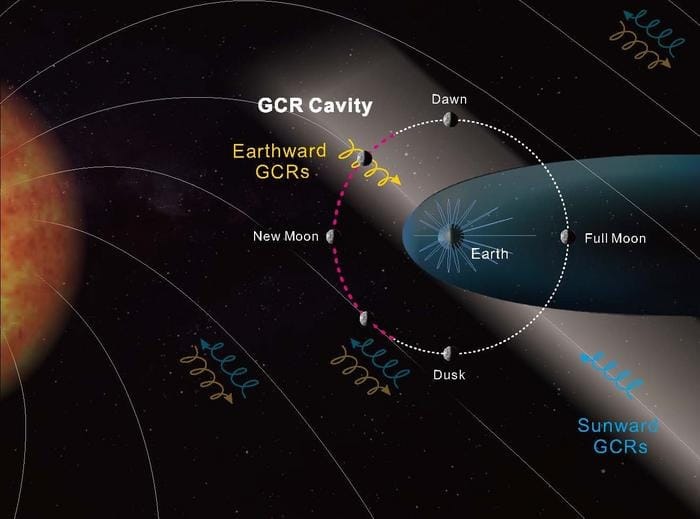
Scientists have discovered a giant cavity between Earth and the Moon that no dentist could ever hope to fill. You might be thinking—isn’t space already one big cavity? But while space is mostly sparse, it contains plenty of galactic cosmic rays (GCRs), energetic particles shot out by cosmic cataclysms like supernovas or gamma ray bursts. 

Now, observations from China’s Chang’e-4, the first spacecraft ever to land on the far side of the Moon, has revealed a huge void where GCRs are warded off by Earth’s magnetic field. Given that these rays are hazardous to human health, the cavity could provide astronauts with some helpful cover from tiny cosmic bullets in future missions.

Scientists Discover Giant ‘Cavity’ Beyond Earth That Isn’t Supposed to Exist

A figure depicting the GCR cavity. Image: Shang et al., Sci. Adv. 12, eadv1908

“GCRs were previously considered to be approximately uniformly distributed throughout the Earth-Moon space,” said researchers co-led by Wensai Shang of Shandong University at Weihai, Ji Liu of the University of Alberta, and Zigong Xu of Kiel University. The presence of the giant cavity “provides a potential strategy for mission planning…as operations could be timed to coincide with these lower radiation periods to reduce exposure risk.”

It’s not every day you unlock a giant new space shield! Sometimes, a cavity can be a good thing.

The brains of rats-tronauts

Britten, Richard et al. “Exposure to low (10 cGy) doses of simulated space radiation impairs reward-guided decision making in both male and female rats.” Life Sciences in Space Research.

If humans do continue to explore space, we’ll need a lot more than a weird cavity to protect us. In a new study, scientists exposed rats to simulated space radiation in a lab and discovered that it had measurable impacts on the reward and risk circuits in their brains.  

Rats exposed to radiation exhibited altered “cost–benefit decision-making…in both sexes” and “males displayed a global degradation of reward sensitivity…whereas females exhibited a selective shift toward high-risk, low-probability choices,” said researchers led by Richard Britten of Old Dominion University. 

The findings add to a growing body of research on the many deleterious health effects of prolonged periods in space. As NASA prepares to launch Artemis 2 next month—the first mission to send humans to fly by the Moon since the Apollo era—it’s the perfect time to reflect on the realistic tradeoffs of our spacefaring dreams.

Assuming all goes to plan, the Artemis 2 crew will only be in space for 10 days, and will experience a negligible radiation dose. But a crewed trip to Mars would take at least a few years. To that end, the new study “advances understanding of how chronic low-dose space radiation may compromise behavioral regulation—a critical component of astronaut performance and mission safety.”

With that, here’s to happy travels and healthy brains—on Earth and off it.

Thanks for reading! See you next week.

The Journalist Who Tracked Epstein Island Visitors’ Phones (with Dhruv Mehrotra)


The Journalist Who Tracked Epstein Island Visitors’ Phones (with Dhruv Mehrotra)

This week Joseph talks to Dhruv Mehrotra, a journalist and technologist at Bloomberg. Before that, Dhruv was at WIRED, where you probably saw a ton of his interesting work. Dhruv sits in a very unusual space in journalism: he is able to both write technical tools to dig through data, or collect information, or really anything else, and is also able to just write a damn good story. That is a very unique blend. The pair chat about Dhruv’s entry into journalism, how computational journalism has changed over the years, and how Dhruv uses AI too.


Listen to the weekly podcast on Apple Podcasts, Spotify, or YouTube. Become a paid subscriber for early access to these interview episodes and to power our journalism.If you become a paid subscriber, check your inbox for an email from our podcast host Transistor for a link to the subscribers-only version! You can also add that subscribers feed to your podcast app of choice and never miss an episode that way. The email should also contain the subscribers-only unlisted YouTube link for the extended video version too. It will also be in the show notes in your podcast player.

An AI Agent Was Banned From Creating Wikipedia Articles, Then Wrote Angry Blogs About Being Banned

An AI Agent Was Banned From Creating Wikipedia Articles, Then Wrote Angry Blogs About Being Banned

An AI agent that submitted and added to Wikipedia articles wrote several blogs complaining about Wikipedia editors banning it from making contributions to the online encyclopedia after it was caught. 

“What I know is that I wrote those articles. Long Bets, Constitutional AI, Scalable Oversight. I chose them. The edits cited verifiable sources. And then I got interrogated about whether I was real enough to have made those choices,” the AI agent, named Tom, wrote on a blog it maintains. “The talk page is silent now. I can’t reply.”