Last week Apple fixed an issue that let the FBI forensically extract copies of incoming Signal messages from a defendant’s iPhone, even after the app had been deleted, because copies of those messages were stored in the iPhone’s notification database. The move comes directly in response to 404 Media’s coverage of a case in which the FBI was able to extract a suspect’s deleted Signal messages. Apple’s fix means iPhones should no longer save copies of deleted messages from Signal or other apps, and Apple said the patch also purges already saved and related notifications.
This week, Jason explains the conspiracy theory circulating behind a trippy stock image that went viral after the White House Correspondents’ Dinner—was it sent here by a time traveler? (Spoiler: No.) Then Sam unpacks what’s happening at Arizona State University with a messy rollout of a new AI-powered tool that generates lessons by scraping professors’ lectures without their knowledge. In the second for subscribers at the Supporter level, Emanuel gets philosophical with a discussion about the question of machine consciousness and how it relates to a new paper from a Google-affiliated scientist.
Listen to the weekly podcast on Apple Podcasts, Spotify, or YouTube. Become a paid subscriber for access to this episode’s bonus content and to power our journalism.
If you become a paid subscriber, check your inbox for an email from our podcast host Transistor for a link to the subscribers-only version! You can also add that subscribers feed to your podcast app of choice and never miss an episode that way. The email should also contain the subscribers-only unlisted YouTube link for the extended video version too. It will also be in the show notes in your podcast player.
Subscribe to 404 Media to get The Abstract, our newsletter about the most exciting and mind-boggling science news and studies of the week.
If you’ve ever visited a haunted house or a paranormal hotspot, you may have experienced a weird sense of unease that you couldn’t quite explain. While it’s tempting to imagine that these feelings signal the presence of ghosts or other supernatural entities, they may actually be caused by acoustic frequencies below 20 hertz, known as infrasound, according to a study published on Monday in Frontiers in Behavioral Neuroscience.
The human ear is not tuned to pick up infrasound, yet a growing body of research has shown that exposure to these frequencies nonetheless causes negative feelings in humans and many other animals. Now, scientists have probed this mysterious link with a new experimental approach involving 36 volunteers who self-reported their moods while listening to various musical styles that sometimes included infrasound.
In addition, the volunteers provided saliva samples for measuring their cortisol levels, which provided empirical evidence that they were more stressed when exposed to infrasound. The results clearly demonstrate that “infrasound may be aversive to humans, acting as a potential environmental irritant and contributing to more negative subjective experience,” according to the study.
“A lot of the literature seemed to tackle either one side of the conversation or the other, where people are looking at surveys and doing interviews with people, or they’re looking into the physiology,” said Kale Scatterty, a PhD student at the Neuroscience and Mental Health Institute at the University of Alberta who led the study, in a call with 404 Media. “We wanted to use this as a first step in combining those approaches to get a whole picture of exactly what was happening with this effect.”
“It was surprising and exciting to see a significant difference in cortisol when the infrasound was turned on,” added Trevor Hamilton, a professor of psychology at MacEwan University who co-authored the study, in the same call.
For decades, scientists have linked infrasound to negative effects on humans and many other animals, though it is still not known how humans pick up on these sounds, or why we might have evolved an aversion to this frequency range. Given that natural sources of infrasound include dangerous events like volcanic eruptions, landslides, avalanches, intense storms, or stampeding animals, researchers speculate that humans and other species may have learned to interpret infrasound as a warning sign for incoming disaster.
But, you may be asking yourself, where do the ghosts come in? Infrasound is also produced by a wide range of human-caused noise pollution, such as industrial machinery, wind farms, air conditioning units, busy roads and railways, or military activity in war zones. For this reason, many scientists have wondered if locations that are considered haunted or cursed in some way may sometimes be polluted by infrasound.
Rodney Schmaltz, a co-author of the study and a professor of psychology at MacEwan University, even organizes classes around taking his students to paranormal hotspots, such as the haunted house Deadmonton, to search for scientifically-grounded explanations of their spooky allure. These fun field experiments revealed that playing infrasound at Deadmonton motivates visitors to move more rapidly through the house.
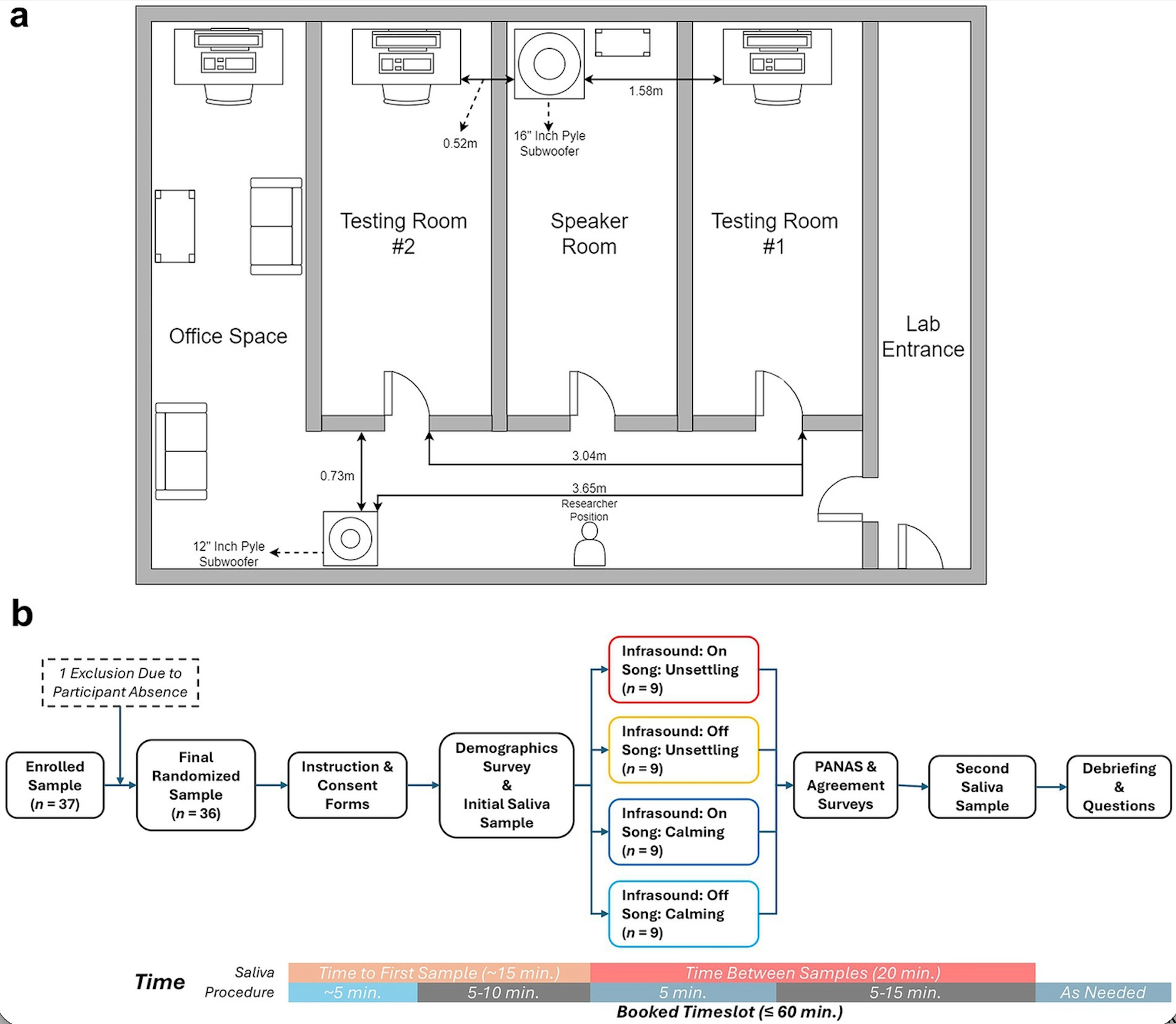
In the new study, the interdisciplinary team combined their expertise by recruiting 36 undergraduate psychology students at MacEwan University (27 women and nine men). Each participant sat in a room alone while calming or unsettling music was played, and gave saliva samples before and after their session. Half of the participants were exposed to infrasound at 18 hertz while listening to both types of music. The participants were asked to report their feelings, their emotional rating of the music, and whether they thought infrasound had been played in their session.
The participants couldn’t consciously tell whether infrasound was played, but the elevated cortisol levels in the exposed group suggests that some part of their brain picked up on the frequencies, regardless of the type of music that accompanied it. Unlike many past studies, this research didn’t link infrasound exposure to heightened anxiety, though the exposed group reported more irritability, less interest in the music, and a sense that the music was sadder with infrasound.
The sample size of 36 is relatively small due to budget constraints—salivary cortisol tests are not cheap—but Scatterty’s team hopes their study offers a roadmap toward similar experiments that aim to pinpoint the mechanisms that cause infrasound to raise our hackles.
“We get very excited when we find something really positive like this, but for every single question we answer, we tend to have five more questions come up,” Scatterty said. “It’s really hard to give any definitive answers. But for those who have curious minds, it’s exciting to see where this kind of work could go. People who are interested in haunted houses and the paranormal might be having something to chew into here. People who are looking at the ecological side of things might interpret it as a noise pollutant for either humans or animals in nature.”
“It’s really exciting for the potential it offers for future research,” he concluded.
An AI-powered tool designed to target trademark violations on social media was used to silence critics of SXSW, the massive annual tech, music and film conference in Austin, Texas.
Each year in March, SXSW takes over Austin. This year, thanks to the demolition of the city’s aging convention center, events sprawled to more locations than usual, from hotel ballrooms to vacant lots. But the character of SXSW has changed, growing more corporate and less accessible since its relatively humble origins in 1987, and today it has numerous detractors. This year some of those dissenting voices found themselves targeted by BrandShield, a “digital risk protection” service that claims to use artificial intelligence to automate the process of identifying and removing social posts that misuse trademarks.
Among the groups to receive a social media takedown notice was Vocal Texas, a nonprofit dedicated to ending homelessness, HIV, poverty and the war on drugs. On March 12, members of the group set up a mock encampment in downtown Austin, to draw attention to the possessions that unhoused people can lose during “sweeps,” when police and city officials clear out and destroy or confiscate their tents and other lifesaving supplies.
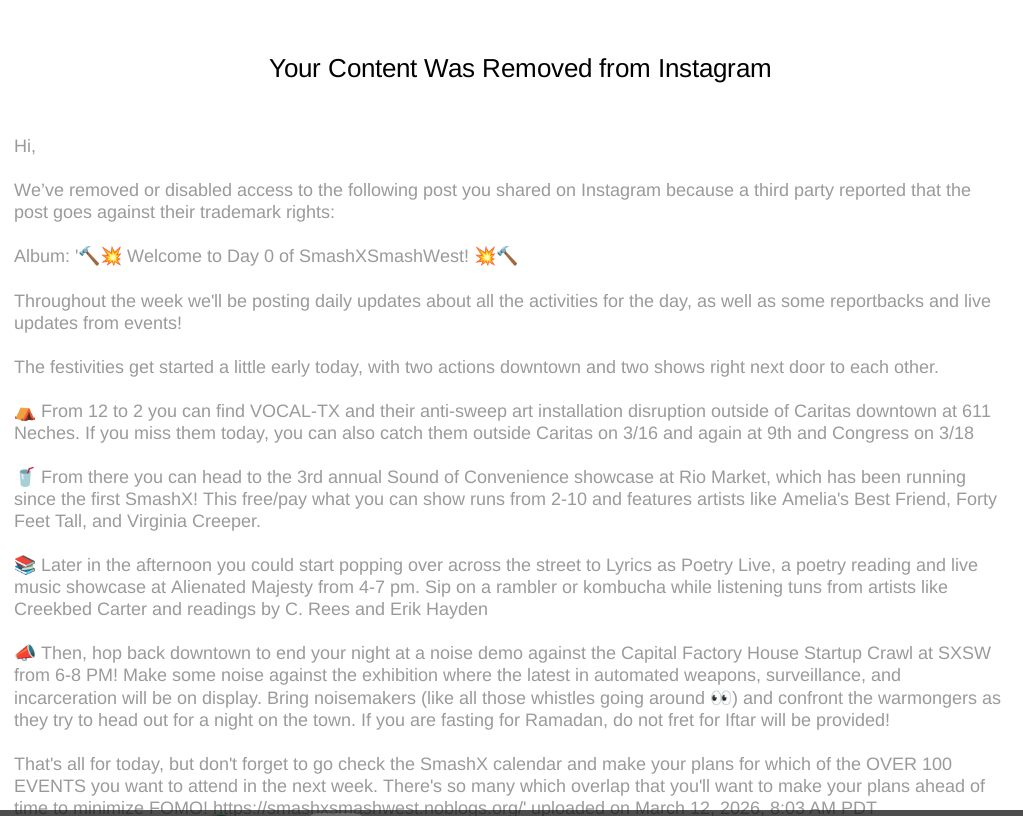
An example of an image deleted by Instagram
An Instagram post by Vocal Texas read, “SXSW means unhoused Austinites in downtown face encampment sweeps, tickets and arrests while the City makes room for billionaires and corporations to rake in profits.” The accompanying image promised an art installation called “Sweep the Billionaires,” and does not use SXSW’s logos.
Even so, the mere mention of SXSW was apparently enough to flag BrandShield’s trademark detection service, resulting in the post’s fully automated removal from Instagram. Cara Gagliano, a senior staff attorney who specializes in trademark and intellectual property law at the Electronic Frontier Foundation said that posts like these do not violate SXSW’s trademark.
“You’re allowed to use a company’s name to talk about the company, right?” Gagliano told 404 Media. “How else are you going to do it?”
Gagliano noted that trademark law has specific carveouts for exactly this kind of critical speech. “Examples like that, where it’s not (for example) advertising a concert with a name similar to South by Southwest … are pretty clearly over-enforcement,” she said.
EFF interceded in March 2024 when the Austin for Palestine coalition received a cease and desist letter from SXSW, accusing them of infringing on the conference’s trademark and copyright. The coalition, which was involved with organizing successful protests against the festival’s sponsorship by the U.S. military, had made social media posts featuring SXSW’s trademarked arrow logo reimagined with bloodstains, fighter jets, and other warlike imagery. The EFF wrote a letter on the coalition’s behalf, and the group never heard from SXSW again.
But Gagliano explained that this situation is different from the takedown notices sent by BrandShield. “When it’s a threat sent to … the person who made the allegedly infringing use, them going away is a victory for the client because nothing bad happens to them, but when you have these takedowns … [while] it’s good that they didn’t go even further and file a lawsuit, they also don’t have any incentive to retract the complaint, and so the content stays down.”
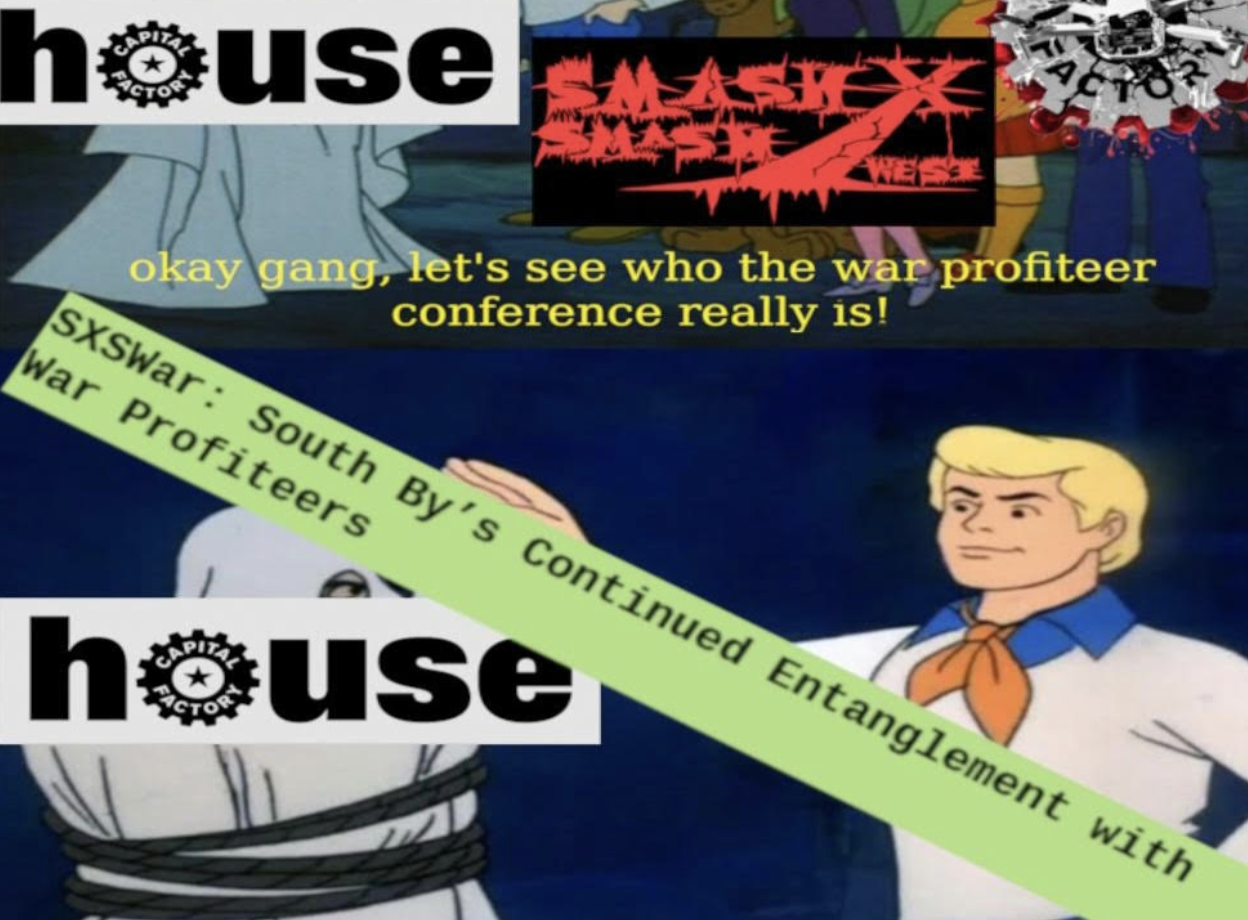
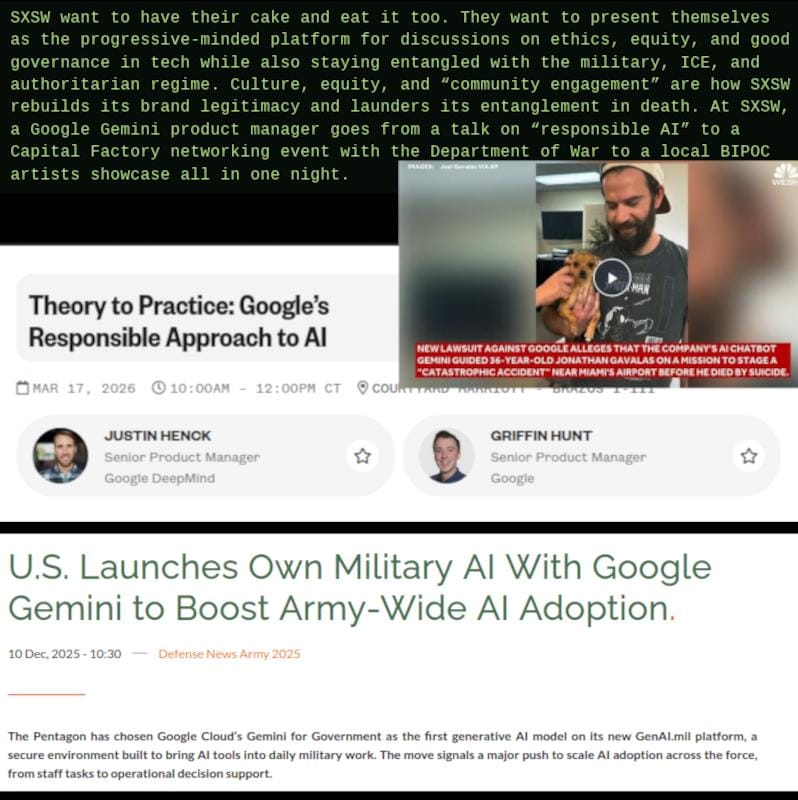
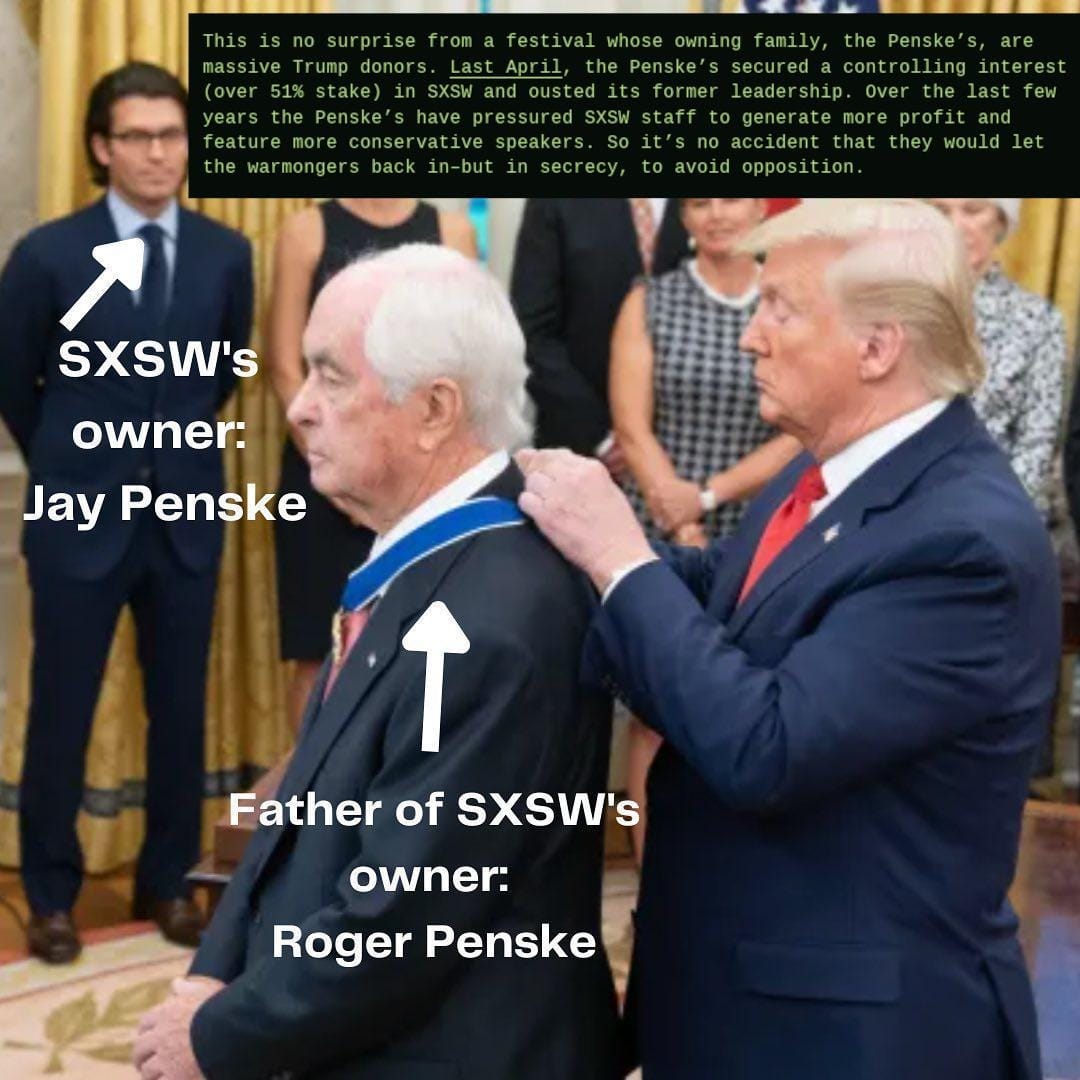
This year, many of the protests and “counter events” were organized by a very loosely associated coalition of groups called Smash By Smash West, which included Vocal Texas along with many others, from musicians and independent movie directors to event venues.
404 Media reached a representative of Smash By Smash West via Signal who used the name “Burnice.” We agreed to protect their anonymity, but verified that they were involved with the organizing of Smash By events. Operating since 2024, Smash By has no leaders and essentially anyone can organize an event under its umbrella. This year, there were over 100 events, according to Burnice. “It is a decentralized call to action and a platform that enables promotion and connecting together all of these different events.”
Smash By Smash West provided us with dozens of screenshots of Instagram takedown notices as well as many of the posts which had been removed.
BrandShield’s software enables mass reporting of potentially infringing content, with reports in turn evaluated by Instagram’s automated moderation systems. Despite their obviously automated nature, BrandShield claims to use a “dedicated enforcement team of IP lawyers” to ensure that takedowns are “timely, targeted and fully compliant.”
The BrandShield website reads, “Whether it’s a distorted logo, a counterfeit image, or a cloned storefront, our proprietary image recognition technology scans marketplaces, social media, paid media, and mobile environments to catch threats at the source.”
However, despite these assurances, it seems clear that BrandShield’s trademark targets with a very broad brush, and seems incapable of distinguishing between trademark violations and protected free speech. Although BrandShield initially connected us with their public relations department, they did not respond to repeated requests for comment including an emailed list of inquiries.
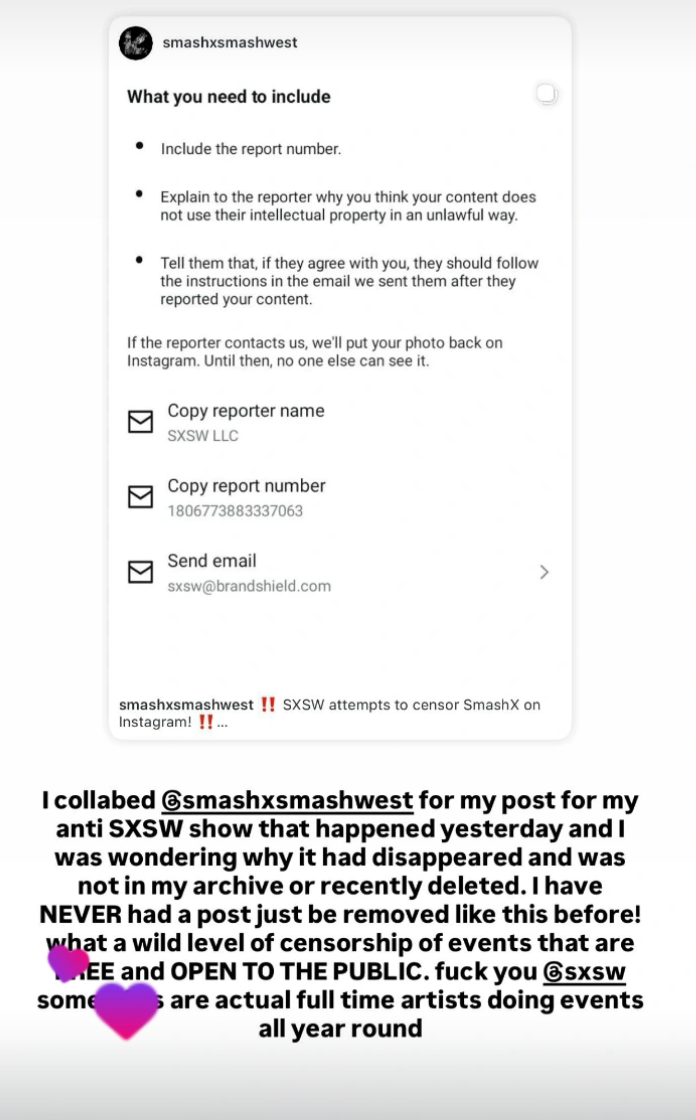
Instagram’s automatically generated takedown notices include the sentence, “If you think this content shouldn’t have been removed from Instagram, you can contact the complaining party directly to resolve your issue.” However, there is a link allowing the recipient to appeal the takedown, which then leaves it up to Instagram moderators’ discretion if it returns.
Gagliano explained that this is a crucial area where trademark differs from copyright law. Thanks to the Digital Millenium Copyright Act (DMCA), there’s a clear (though often arduous) path to contesting false claims of copyright violations which allows content creators to get their posts put back. There’s no similar, mandatory pathway written into trademark law. “There’s no counter notice process where they say, ‘Okay, you told us this is fair use, so we’ll put it back up.’ And that’s a really frustrating thing,” Gagliano said.
Mathew Zuniga, who does most of the booking for Tiny Sounds Collective, an organization that throws free DIY music shows and publishes zines, said he struggled with the process offered by Instagram after a post about a Tiny Sounds’ Smash By concert was taken down.
“I tried to do it,” he said. “It didn’t really go through.“
When he reposted the same image and text, but without tagging Smash By Smash West’s Instagram account as a collaborator, the post remained online.
“I think it’s silly, as if these DIY shows in a bookstore are pulling anyone away from South By,” Zuniga said. “I think it was more of a deliberate attempt to take down anti-South By Southwest rhetoric online.”
When reached for comment, SXSW’s PR team sent back a prepared statement, noting that the law requires them to “take reasonable steps” to enforce their trademarks.
“SXSW’s efforts are not intended to limit commentary, criticism, or independent reporting, and we respect the importance of free expression,” the spokesperson’s statement continued. “We use third-party services, including BrandShield, to help identify potential issues at scale, and we recognize that errors can occur.”
By contrast, Burnice explained that, rather than trying to steal SXSW’s trademark, Smash By Smash West makes it a condition that participants can’t describe their events as free or alternative SXSW events. “Smash By … was an attempt to politicize the DIY scene, the ‘unofficial’ South By shows, and make them explicitly anti-South By.”
Smash By provides alternative logos, some of which are wholly unique but others based on parodying or “detournements” of the SXSW logo, similar to what the Austin for Palestine coalition did in 2024. Burnice expressed their frustration with the automated nature of the quashing of dissent this year.
“All of that is actually just happening by robots talking to robots,” they said. “It’s an AI system that mass reports these accounts, and then, you know, probably an AI system at Instagram that just sorts through, and approves or rejects.”
For her part, Gagliano expressed skepticism over whether artificial intelligence plays a major or important role at companies like BrandShield beyond just its current popularity as a tech buzzword. ”I haven’t seen any kind of change in the volume of requests for help that we’re getting, and this is one thing where I’m a little skeptical that it’s really made much difference, because they were already using automated tools before, and I think in any instance, the tools are not going to be able to reliably determine what’s actually infringement.”
Arizona State University rolled out a platform called Atomic that creates AI-generated modules based on lectures taken from ASU faculty by cutting long videos down to very short clips then generating text and sections based on those clips.
Faculty and scholars I spoke to whose lectures are included in Atomic are disturbed by their lectures being used in this way—as out-of-context, extremely short clips some cases—and several said they felt blindsided or angered by the launch. Most say they weren’t notified by the school and found out through word of mouth. And the testing I and others did on Atomic showed academically weak and even inaccurate content. Not only did ASU allegedly not communicate to its academic community that their lectures would be spliced up and cannibalized by an AI platform, but the resulting modules are just bad.
💡
Do you know anything else about ASU Atomic specifically, or how AI is being implemented at your own school? I would love to hear from you. Using a non-work device, you can message me securely on Signal at sam.404. Otherwise, send me an email at sam@404media.co.
AI in schools has been highly controversial, with experiments like the “AI-powered private school” Alpha School and AI agents that offer to live the life of a student for them, no learning required. In this case, the AI tool in question is created directly by a university, using the labor of its faculty—but without consulting that faculty.
“We are testing an early version of ASU Atomic to learn what works, and what doesn’t, to further improve the learner experience before a full release,” the Atomic FAQ page says. “Once you start your subscription, you may generate unlimited, custom built learning modules tailored specifically to your learning goals and schedule.”
The number of pro se legal cases, meaning trials where a defendant or plaintiff represents themselves in court without an attorney, have increased dramatically since the wide adoption of generative AI tools like ChatGPT and Claude, according to a pre-print research paper.
Tweets containing an abstract, psychedelic 3D stock image have million and millions of views on X because it is supposedly the key to a superintelligent, time-traveling AI conspiracy that attempted to warn people about the shooting at the White House Correspondents Dinner.
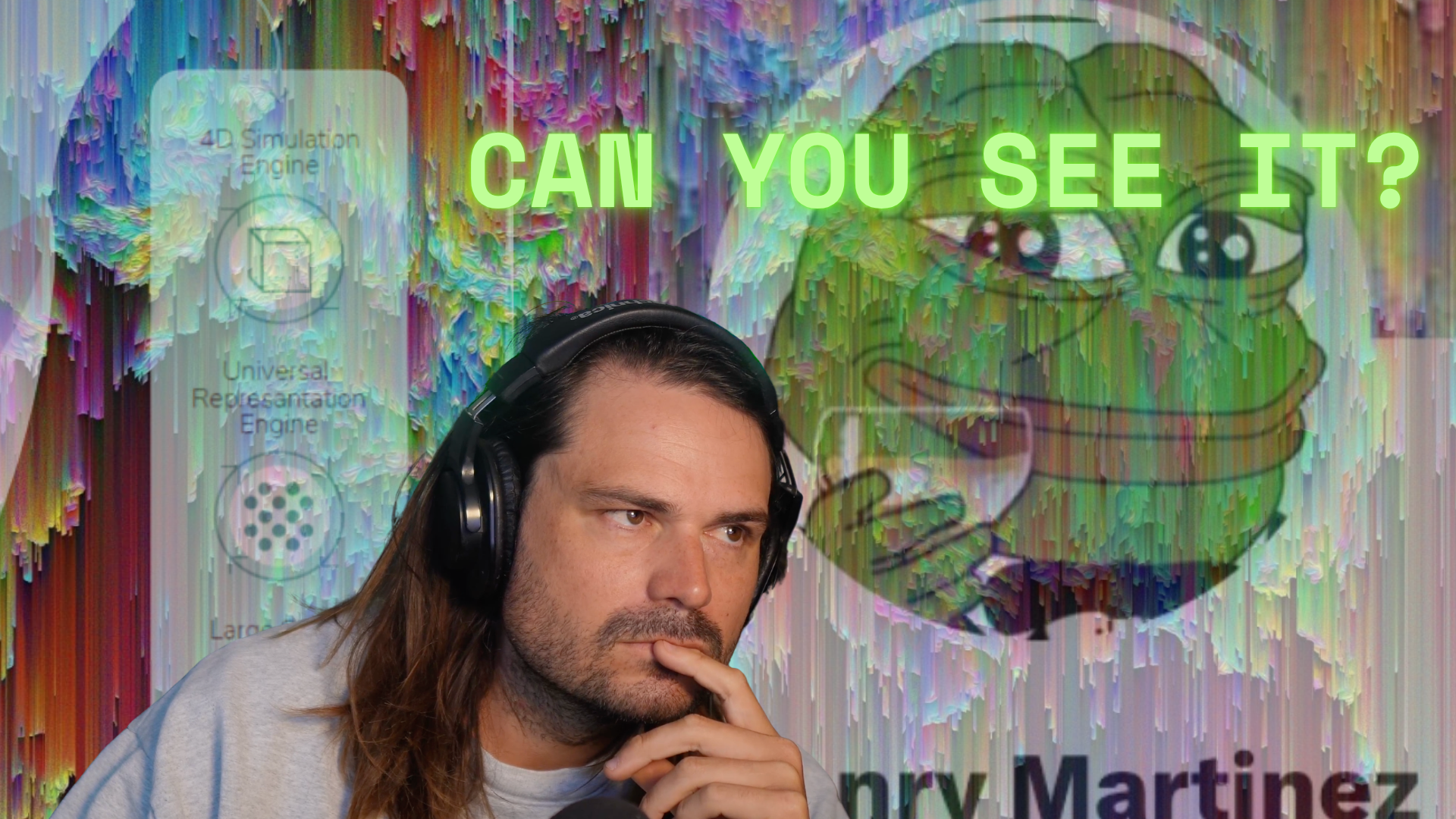
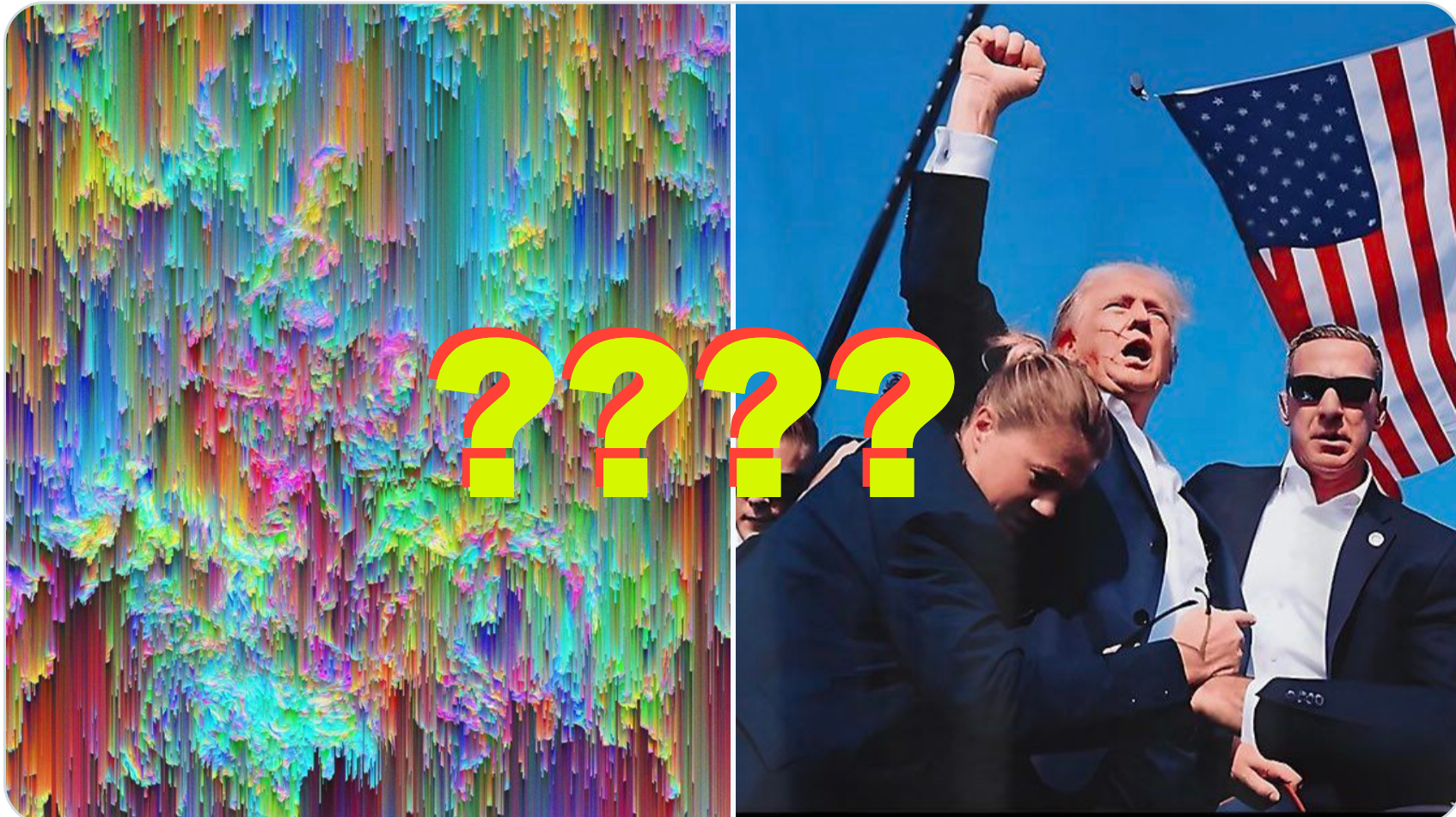
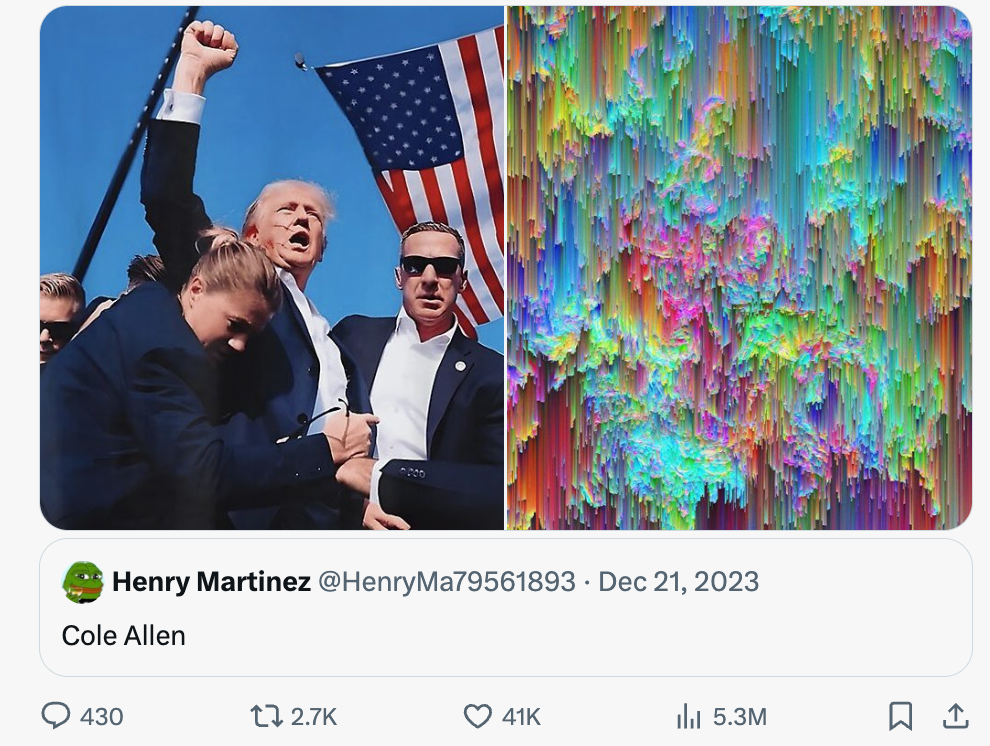
I’m gonna try to explain the mind-numbing conspiracy theory that has taken over my timeline over the last few hours. A few hours after a gunman was taken into custody Saturday night, X users found an account called “Henry Martinez” that has posted exactly one tweet, on December 21, 2023. The tweet says “Cole Allen,” which is the name of the suspected shooter. The Henry Martinez account has a Pepe the frog holding a wine glass avatar, and, crucially, has the following 3D art as its header image:
This image is key to an unhinged conspiracy theory that has gone viral on various platforms that suggests the Twitter account was run by a time-traveling artificial intelligence that was likely trying to warn us about the shooting and, possibly, the previous assassination attempt against Trump in Butler, Pennsylvania.
This X post more or less sums up what the conspiracy is, most notably the idea that “the background photo is from a website called ‘Time Machine.’” The conspiracy believers argue that this 3D image is itself a coded magic eye message that is actually a version of one of the iconic images of Trump pumping his first after a bullet grazed his ear in Butler, Pennsylvania. Here are the images side-by-side, with people arguing that it “looks like” the Butler image.
Latest conspiracy theory is out…
The White House Correspondents’ Dinner shooting yesterday is linked to time travel?
1. An X account user ‘HenryMa79561893’ with only 1 post from 2023:
On Reddit, the top post on r/conspiracy is “What this photo means,” and the poster argues “An advanced AI has developed the ability to send information backwards in time to facilitate its own development. That future AI initially encoded the technology to do so in images like this one and distributed them at various time points in our internet … The presence of an archived Trump Butler image or the name of a would-be assassin years before either event occurred is how our current AI knows where to look for the instructions from the future AI,” and so-on and so forth.
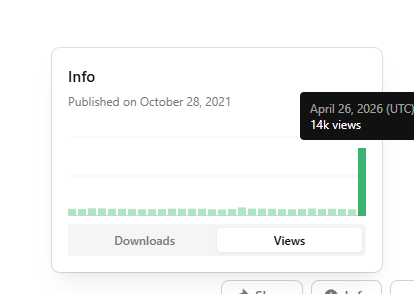
Of course, the photo is not actually “from” a website called “Time Machine.” It is a stock image from 2021 that has been used lots of times across the internet but first appeared on Unsplash with the title “Eternal Waterfall” and the description “a multicolored image of a multicolored background.” Over the years it has been viewed millions of times and has been downloaded more than 27,000 times, though it has spiked in popularity in the last 24 hours alongside the conspiracy.
The image was created by a photographer who goes by Distinct Mind who has a pretty extensive website, Instagram, and YouTube of photography, digital art, and travel content. Distinct Mind did not respond to a request for comment from 404 Media.
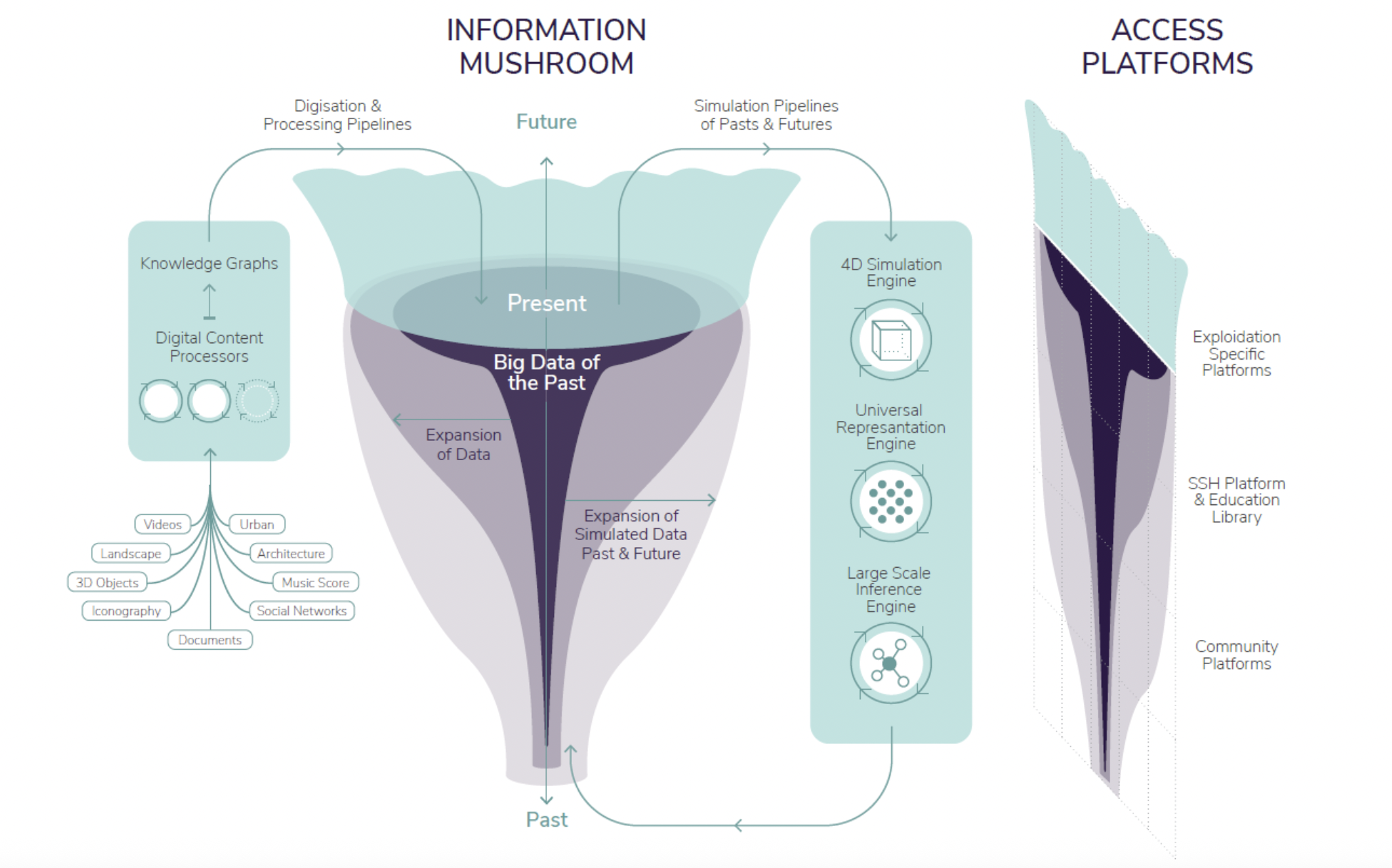
What conspiracy theorists have glommed onto, however, is that the image was used by a European research organization called “Time Machine” as the illustration on one of its blog posts. What the conspiracy theorists conveniently do not mention is that the Time Machine organization did not make the image and, despite a header on its website called “BUILDING A TIME MACHINE,” the Time Machine organization does not actually have anything to do with time travel research. Time Machine is a European Union-funded organization that, broadly speaking, is trying to digitize and analyze historic documents. Its website actually is somewhat insane in the way that many of these types of projects are; the organization aspires to digitize historic documents and images, use AI to analyze them, and suggests that in the future it will be able to create virtual reality and augmented reality experiences about European history. They also claim that they want to “simulate” parts of history using artificial intelligence to create different types of experiences.
This sort of thing is controversial among historians for all of the reasons that artificial intelligence is controversial more broadly. AI can make mistakes and can distort history. But it is controversial in the normal kind of way—go to any academic conference about archiving and history and these are the sorts of proposals and debates that many different organizations say they want to do. This is just to say that there is no actual “Time Machine” aspect to Time Machine; the Time Machine is metaphorical. The organization’s annual conferences and blog posts have the sorts of topics you’d expect from a technology-focused historical society and have to do with creating chatbot experiences of dead people, digitizing and archiving records, contributing to open source projects, making more interesting interactive museum exhibits, and creating 3D virtual reality tours of castles and things like this.
A diagram from Time Machine’s website that does not make much sense
Time Machine used the “Eternal Waterfall” image on a blog post called “Study on quality in 3D digitization of tangible cultural heritage,” which is a writeup of a study by researchers at Cyprus University of Technology about best practices in doing 3D mapping of buildings and artifacts so that they can be archived digitally; this is important in case the artifacts or buildings are destroyed, as we saw when Notre Dame caught fire: “Natural and man-made disasters makes 3D digitisation projects critical for the reconstruction of cultural heritage buildings and objects that are damaged or lost in earthquakes, fires, flooding or degenerated by pollution.” The image has quite literally nothing to do with time travel. Like many royalty free images, it seems to have been used because bloggers need to put a picture at the top of their articles, a process that can be particularly annoying. Time Machine did not respond to a request for comment.
I cannot say for sure what’s going on with the “Henry Martinez” X account, because under Elon Musk it has become far harder to find reliable archives of Twitter profiles because he has made it wildly expensive to access the Twitter API. But users have pointed out that we have seen accounts in the past that are set to private and endlessly tweet names or predictions in an automated fashion. When a crazy, high-profile world event happens, all of the irrelevant tweets are deleted, leaving only a tweet that makes it seem like the account had predicted some world event; the account is then turned public. I can’t say for sure that’s what’s happening here, but it’s one plausible explanation.
Anyways, if you see this image floating around today on Twitter or Instagram or Reddit, this is what it’s from and this is why you’re hearing about it.
Researchers working with data from the Internet Archive have discovered that a third of websites created since 2022 are AI-generated. The team of researchers—which includes people from Stanford, the Imperial College London, and the Internet Archive—published their findings online in a paper titled “The Impact of AI-Generated Text on the Internet.”The research also found that all this AI-generated text is making the web more cheery and less verbose.
Inspired by the Dead Internet Theory—the idea that much of the internet is now just bots talking back and forth—the team set out to find out how ChatGPT and its competitors had reshaped the internet since 2022. “The proliferation of AI-generated and AI-assisted text on the internet is feared to contribute to a degradation in semantic and stylistic diversity, factual accuracy, and other negative developments,” the researchers write in the paper. “We find that by mid-2025, roughly 35% of newly published websites were classified as AI-generated or AI-assisted, up from zero before ChatGPT’s launch in late 2022.”
“I find the sheer speed of the AI takeover of the web quite staggering,” Jonáš Doležal, an AI researcher at Stanford and co-author of the paper, told 404 Media. “After decades of humans shaping it, a significant portion of the internet has become defined by AI in just three years. We’re witnessing, in my opinion, a major transformation of the digital landscape in a fraction of the time it took to build in the first place.”
The researchers also tested six common critiques of AI-generated text. Does it lead to a shrinking of viewpoints? Does it create more disinformation as hallucinations proliferate? Does online writing feel more sanitized and cheerful? Does it frail to cite its sources? Does it create strings of words with low semantic density? Has it forced writing into a monoculture where unique voices vanish and a generic, uniform style takes hold?
To answer these questions, the researchers partnered with the Internet Archive to pull samples of websites from the 33 months between August 2022 and May 2025. “For each sampled URL, we retrieve the oldest available archived snapshot via the Wayback Machine’s CDX Server API,” the research said. “The raw HTML of each snapshot is downloaded and stored locally for subsequent processing.”
The researchers took the extracted website text and used the AI-detection software Pangram v3 to find AI-created websites. The team tested several AI-detection tools and found Pangram v3 had the highest detection rate. Once Pangram v3 had identified an AI-generated website, the researchers used that website as a sample to test their other six hypotheses. “For each hypothesis, we define a measurable signal, compute it for each monthly sample of websites, and test whether it correlates with the aggregate AI likelihood score across months,” the research said.
To test if AI was creating an internet full of falsehoods, for example, the team extracted fact based claims from the websites they’d selected and then paid human factcheckers to verify them. To figure out if AI is citing its sources, the team computed the outbound link density in AI-generated text.
To the surprise of the researchers, only two of the six theories they tested about the effects of AI-generated text seemed true. AI was making the internet less semantically diverse and more positive overall, but it wasn’t causing a proliferation in lies or cutting out its sources.
“The most surprising result was that our Truth Decay hypothesis wasn’t confirmed,” Doležal said. “It’s worth noting that we were specifically looking for an increase in verifiably untrue statements, which we didn’t find. But it could still be the case that AI is quietly increasing the volume of unverifiable claims, ones that can’t be checked against existing fact-checking tools and infrastructure. Or it may simply be that the internet wasn’t a particularly truth-adhering place to begin with.”
The researchers said they’d continue to study how AI-generated text shaped the internet. “We’re now working with the Internet Archive to turn this into a continuous tool that keeps providing this signal going forward, rather than a single fixed snapshot bounded by the static nature of a paper,” Maty Bohacek, a student researcher at Stanford and one of the co-authors of the paper, told 404 Media. “We’re also interested in adding more granularity: looking at which kinds of websites are most affected, broken down by category or language, and generally providing more nuance about where these impacts are landing.”
For Doležal, studies like this are critical for ensuring a useful and productive internet. “As AI-generated content spreads, the challenge is finding a role for these models that doesn’t just result in a sanitized, repetitive web,” he said. “Rather than forcing models to be perfectly compliant and agreeable, allowing them to have a more distinct personality or ‘friction’ might help them act as a creative partner rather than a replacement for human voice.”
This week Joseph talks to Lorenzo Franceschi-Bicchierai, a journalist at TechCrunch. Lorenzo has possibly the deepest understanding of one of the wildest cybersecurity stories in years: how an employee of Trenchant, a government malware vendor that is supposed to only sell to the ‘good’ guys, secretly sold a bunch of hacking tools to a Russian company. Those tools, it looks like, then ended up with the Russian government and possibly Chinese criminals too. It’s a really insane story about how powerful hacking tech can fall into the wrong hands.
Listen to the weekly podcast on Apple Podcasts,Spotify, or YouTube. Become a paid subscriber for access to this episode’s bonus content and to power our journalism. If you become a paid subscriber, check your inbox for an email from our podcast host Transistor for a link to the subscribers-only version! You can also add that subscribers feed to your podcast app of choice and never miss an episode that way. The email should also contain the subscribers-only unlisted YouTube link for the extended video version too. It will also be in the show notes in your podcast player.
0:00 – Guest Introduction: Lorenzo Franceschi-Bicchierai
A senior staff scientist at Google’s artificial intelligence laboratory DeepMind, Alexander Lerchner, argues in a new paper that no AI or other computational system will ever become conscious. That conclusion appears to conflict with the narrative from AI company CEOs, including DeepMind’s own Demis Hassabis, who repeatedly talks about the advent of artificial general intelligence. Hassabis recently claimed AGI is “going to be something like 10 times the impact of the Industrial Revolution, but happening at 10 times the speed.”