I’ve been in the data game long enough to see plenty of AI projects crash and burn.
I started my career building data warehouses for telcos and banks, then moved into machine learning consulting, where I led hundreds of projects across industries. Now I’m leading data analytics and machine learning at Phenom, and I want to share something we recently built that actually works.
Let me be clear about what I mean when I say “Gen AI” here. I’m talking about LLMs and the tools built on top of them. The “old school ML” I’ll reference means those low-complexity supervised models we’ve been using for years, the ones that are fast, cheap, and reliable by nature.
Phenom provides banking solutions for SMEs across Europe, but at our core, we’re a B2B fintech scale-up. Each of these words carries weight.
Being B2B means every single client counts. We can’t mess around with client communications or operations. Everything that touches our clients’ needs to meet a certain standard, no exceptions.
Being a fintech means we love technology, sure, but we’re also bound by regulations. The Financial Crimes Enforcement Network doesn’t care how innovative your solution is if it doesn’t meet compliance standards.
And being a scale-up? That means we can’t afford AI theater. We have some budget for innovation and experimentation, but every investment needs to demonstrate real efficiency gains and positive ROI.
These constraints shaped our entire approach to AI and machine learning at Phenom. We’ve established two fundamental pillars that guide everything we build.
First, we successfully convinced leadership (all the way up to the board) that while AI is nice, having a solid data foundation and platform is even better. When you’re dealing with regulatory reporting or enabling better tactical and strategic business decisions, that foundation matters more than any flashy AI feature.
Second, we developed clear ground rules for when to use which technology. When we need stability and structured signals, we reach for traditional machine learning first. When we’re dealing with messy input data like customer reviews or unstructured text, we consider generative AI.
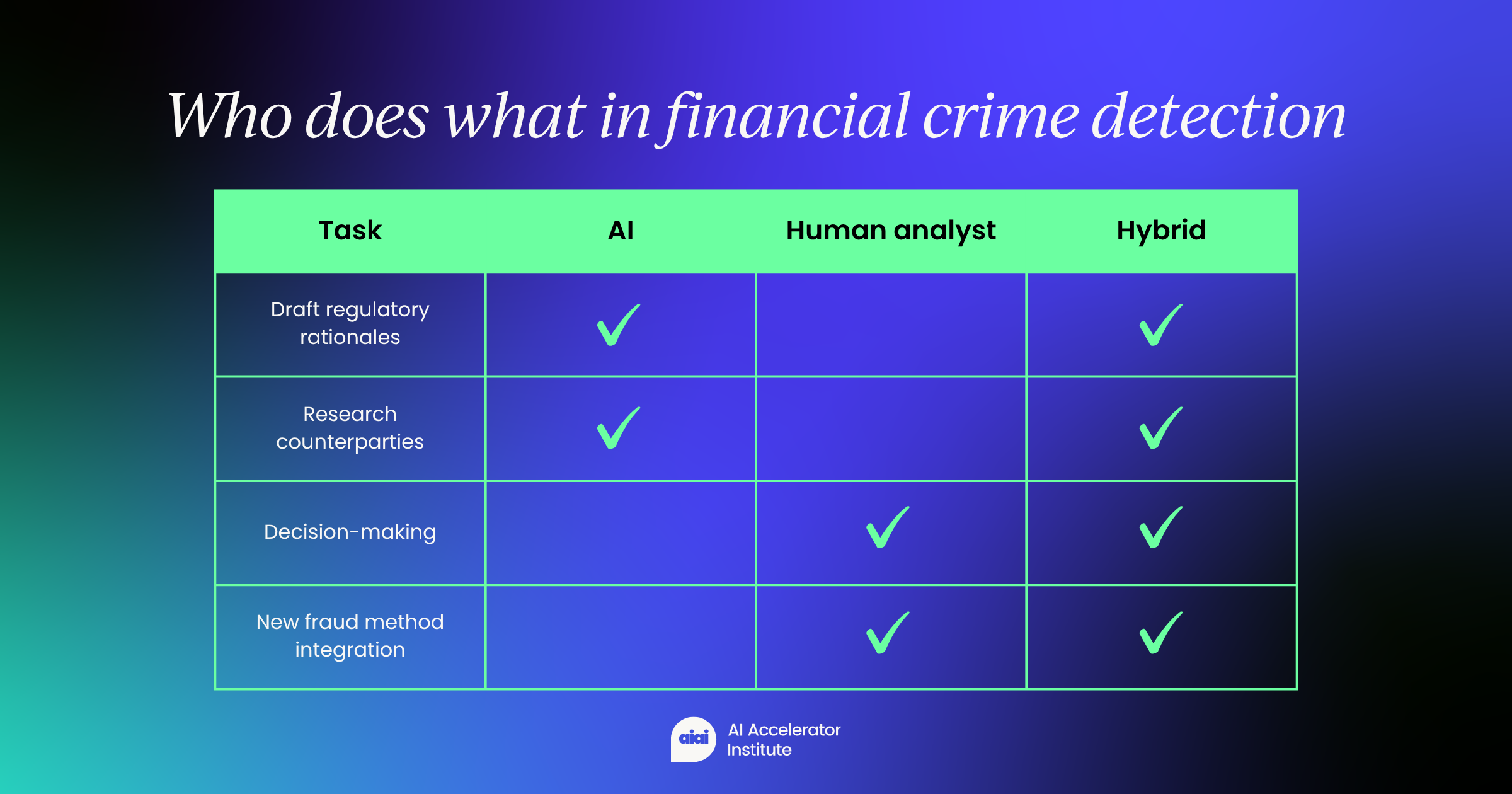
High-risk scenarios involving financial crime, regulations, or customer care always get hybrid solutions with humans in the loop. Low-risk internal use cases? That’s where we let AI shine and can afford the occasional mistake.
For expert advice like this straight to your inbox every other Friday, sign up for Pro+ membership.
You’ll also get access to 300+ hours of exclusive video content, a complimentary Summit ticket, and so much more.
In 1969, the three astronauts of the Apollo 10 mission conducted a momentous “dress rehearsal” for putting humans on the lunar surface for the first time. It was a historic, inspiring moment for humanity; Astronaut John Young watched from a command module spacecraft as Thomas Stafford and Gene Cernan broke away and flew a lunar module within 10 miles of the moon’s surface, then reunited to return home to Earth. It’s from this mission that we have one of the most powerful transcripts in NASA history:
“Who did what?” Young asked. “Where did that come from?” Cernan added.
“Give me a napkin quick,” Stafford said. “There’s a turd floating through the air.”
The provenance of the poop remains one of the great mysteries of spaceflight. Today, in the early Earth-morning hours of the Artemis II astronauts’ history-mirroring mission around the moon, we have another: Why is Microsoft Outlook not working in space?
On April 1, four astronauts from the U.S. and Canada embarked on a 10-day flight to loop around the moon. Spotted by VGBees podcast host Niki Grayson on the NASA livestream of live views from the , around 2 a.m. ET, Kennedy Space Center mission control acknowledges an issue with a process control system and offers to remote in—yes, like how your office IT guy would pause his CoD campaign to log into Okta for you because you used the wrong password too many times.
One of the astronauts, Reid Wiseman, says that’s chill, but while they’re in there: “I also see that I have two Microsoft Outlooks, and neither one of those are working.”
right now the astronauts are calling houston because the computer on the spaceship is running two instances of microsoft outlook and they can’t figure out why. nasa is about to remote into the computer
Astronauts are trained for decades in some of the most physically and mentally grueling environments of any career. They’re some of the smartest people on the planet, and they have to be, before we strap them to 3.2 million pounds of jet fuel and make them do complex experiments and high-stakes decisions for days on end. And yet, once they get up there, fucking Outlook is borked.
I scanned through the next several minutes after this moment and didn’t hear them address the duplicate Outlooks again. So, I emailed the Artemis II communications team, who is definitely not busy today I’m sure, and asked: Can the astronauts check their email yet?
TeleGuard, an app that markets itself as a secure, end-to-end encrypted messaging platform which has been downloaded more than a million times, implements its encryption so poorly that an attacker can trivially access a user’s private key and decrypt their messages, multiple security researchers told 404 Media. TeleGuard also uploads users’ private keys to a company server, meaning TeleGuard itself could decrypt its users’ messages, and the key can also at least partially be derived from simply intercepting a user’s traffic, the researchers found.
The news highlights something of the wild west of encrypted messaging apps, where not all are created equal.
“No storage of data. Highly encrypted. Swiss made,” the website for TeleGuard reads. The site also says, “The chats as well as voice and video calls are end-to-end encrypted.”
💡
Do you know anything else about this app or other security issues? I would love to hear from you. Using a non-work device, you can message me securely on Signal at joseph.404 or send me an email at joseph@404media.co.
In March an anonymous security researcher, who didn’t provide their name, told 404 Media about a series of vulnerabilities in TeleGuard. They included the fact the TeleGuard app uploads users’ private encryption keys to the company’s server upon account registration.
Often when implementing encrypted messages, apps will assign users a public and private key. The public key is what other users use to encrypt messages for them, and the private key is what a user uses to decrypt messages meant for them. If this key falls into someone else’s hands, they may be able to read a users’ messages.
In true end-to-end encryption, this encryption happens on a user’s phone, and the key should never leave that device. With TeleGuard, the app is transmitting that highly sensitive key to the company’s servers. Technically, the app uploads an encrypted version of the private key, but it also transmits other information that allows the server to decrypt it, the researcher explained. That includes the user’s unique ID, which is also uploaded along with the key; a hardcoded salt (which in cryptography is supposed to be a random string of characters, but in this case is constant); and a hardcoded nonce (which is also supposed to be random for every communication to stop certain attacks, but is constant with TeleGuard). “The server can decrypt every user’s private key. It has everything,” the researcher wrote in their findings shared with 404 Media.
That series of design decisions means TeleGuard, the company, receives users’ private keys. But the keys are also accessible to other attackers. The researcher found it’s possible to retrieve a specific user’s private key by simply plugging their user ID into TeleGuard’s API. Many people share their user ID publicly so they can be contacted, opening them up to this attack.
404 Media asked Dan Guido, CEO and co-founder of cybersecurity firm Trail of Bits, whether his team was able to verify the findings. Guido said the company found much the same thing, and added the app’s encryption “is meaningless,” because of the app uploading the private keys and the server’s ability to decrypt them.
Trail of Bits then found multiple other security issues with TeleGuard, including being able to at least partially extract users’ private keys from simply intercepting their traffic. Trail of Bits said it then successfully decrypted one of the shoddily encrypted private keys from that capture.
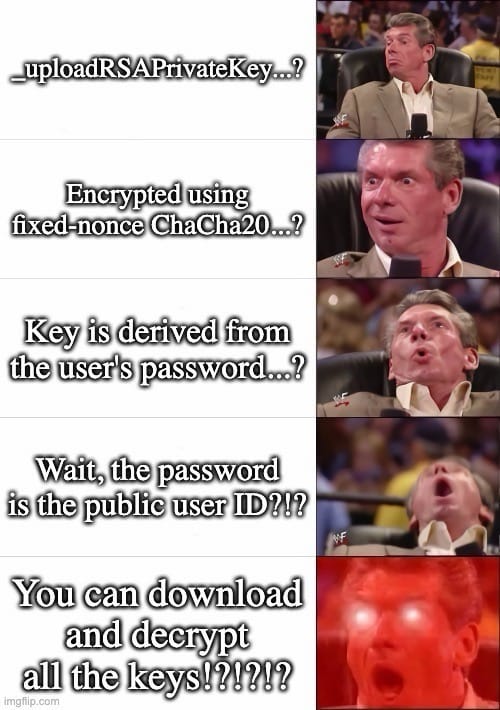
Guido sent 404 Media this meme:
Image: meme via Trail of Bits.
The researcher who initially reached out also said TeleGuard’s metadata—when someone sent a message, and to whom—is in plaintext, meaning that could be exposed to attackers too.
TeleGuard launched in around 2021, according to archives of the app’s page on the Wayback Machine. It is made by Swisscows, a company that also makes what it describes as an anonymous search engine, a VPN, and an email service. In a promotional video, TeleGuard claims to have “one of the strongest encryptions available.”
Neither TeleGuard nor Swisscows responded to multiple requests for comment, nor gave any indication or timeline of when they might fix the issues.
TeleGuard has been recommended to cam models as a way to communicate, according to a post on a subreddit for models. The app has also repeatedly been linked to child abusers, with one local media outlet reporting TeleGuard is “notorious” among prosecutors for child sexual abuse material. The FBI previously obtained data about a TeleGuard user through push notifications sent to their phone. A foreign law enforcement agency had TeleGuard hand over push notification-related data, which the FBI then took to Google to obtain email addresses linked to that alleged pedophile, The Washington Post reported.
Subscribe to 404 Media to get The Abstract, our newsletter about the most exciting and mind-boggling science news and studies of the week.
Scientists have engineered tobacco plants to produce five psychedelic compounds that are normally found in a wide range of natural sources, including psilocybin mushrooms, ayahuasca, and toads, according to a study published on Wednesday in Science Advances.
The breakthrough could lead to more sustainable and scalable production of these compounds by using model plants to biosynthesize common psychedelic “tryptamines,” such as psilocybin from hallucinogenic mushrooms, N,N-Dimethyltryptamine (DMT) from plants, and psychoactive compounds secreted by the Sonoran Desert toad.
Eventually, this research could pave the way toward—as one example—tomato plants that contain microdoses of psychedelic cocktails in each fruit. However, the study’s authors emphasized that these modified plants would need to be limited to medical use in clinical settings, and should not be accessible to consumers for recreation.
“We are interested in this, not because of the recreational effects, but because of the medicinal potential,” said Paula Berman, a postdoctoral researcher at the Weizmann Institute of Science who co-led the study, in a call with 404 Media.
“This combination of five psychedelics—I don’t think anyone has ever tried something like it,” added senior author Asaph Aharoni, principal investigator and head of the department of plant and environmental sciences at the Weizmann Institute of Science, in the same call.
Tryptamines are a subclass of metabolites—compounds produced by metabolic processes in organisms—which have wide-ranging potential as treatments for conditions such as depression, anxiety, mood disorders, and post-traumatic stress disorder.
Indigenous cultures in many regions have cultivated tryptamines for thousands of years for ritual, spiritual, and therapeutic purposes. These compounds are now in high demand as both recreational drugs and medicinal treatments, though legal regulations governing their use vary widely around the world.
Due to their growing popularity, many of the source organisms that produce these compounds are facing significant ecological stresses in the wild; for example, the Sonoran Desert toad population is rapidly declining due to poaching and over-harvesting. Scientists have produced synthetic versions of some tryptamines, but those methods often involve complicated processing steps and hazardous reactants that generate chemical waste.
To help alleviate these problems, Berman, Aharoni, and their colleagues reconstructed the biosynthetic pathways in five tryptamines: Psilocin and psilocybin, both found in hallucinogenic mushrooms; DMT, which is the psychoactive part of ayahuasca; and the psychedelic compounds bufotenin and 5-methoxy-DMT secreted by the Sonoran Desert toad.
The team then inserted the active genes of these pathways into the leaves of a tobacco plant, creating a botanical platform to produce all five psychedelics. By design, the modified plants are not able to pass these genes onto future generations, as this study is intended to offer a “proof of concept,” Berman said.
“In one leaf, we get five different psychedelics from three different kingdoms,” said Aharoni. “But since it is not inherited, it will stay in the leaves and will not go through to seeds, flowering, pollination, and to the next generation.”
“One reason that we did that is we are still not sure if we want to make plants where everybody can grab seeds from us and grow a plant with five different compounds” that might be deadly, he added. “We have to make sure that it stays in research.”
With that caveat, the team hopes that their work could lead to a method of tryptamine biosynthesis that could help meet the global demand for these compounds. In addition to sidestepping the disadvantages of synthetic versions, this technique could also remove stressors on wild populations. The goal is to ensure that wild tryptamine sources can be reserved for use in traditional Indigenous practices.
The researchers are also interested in clarifying the evolutionary purpose of psychedelic compounds for the plants that naturally produce them, which remains mysterious in many cases.
“We understand the importance of the plants, the fungi, and the Sonoran Desert toad, and every species that we discuss in the paper,” Berman said. “One of our motivations was to really understand better what these species do, so that we can mimic what they do.”
“Over-harvesting endangers the natural availability of these species for native peoples and Indigenous groups,” she concluded. “We have so much respect for the knowledge that they provide us, and we just want to add to this knowledge and to be able to produce these in a more sustainable way.”
🌘
Subscribe to 404 Media to get The Abstract, our newsletter about the most exciting and mind-boggling science news and studies of the week.
Sometimes people—especially those in the field of public relations doing a pray-and-spray campaign, but also small-time developers, the occasional delusional vibe-coder, and local dipshits—deliver messages to my inbox like a cat dropping a dead mouse on my doorstep. For the most part, I resist the bait: often, bad press is still press to these people, or I’m just too busy to really look at the pitch or try the product.
This week, I’m coming back from a week of being entirely offline. I didn’t look at the news or my inboxes for seven straight days. I’m feeling properly healed, and also like I need to retraumatize myself back into the swing of things. Lucky me, on Monday morning, someone representing EnjoyMeNow emailed me about “a mobile website that places a photorealistic 3D character in your real room using augmented reality” using something called “Arousal Intelligence” and “real-time physics,” which streams “in a full engine from a global delivery network.” This press release, sent from “a globally focused media and entertainment holding company pioneering technology-driven innovation across digital platforms worldwide” called DCBG Group which represents EnjoyMeNow, was very thrilling to read as someone who appreciates the art of a good word salad. I dropped what I was doing (deleting hundreds of other emails) to try it out.
Once on the EnjoyMeNow.com mobile site, after agreeing that you’re over 18, you’re asked to choose a “Pleasurette™,” a gender neutral term for a series of 3D characters and a trademark filed two weeks ago. These include five women wearing sex toy store package lingerie, and one dude, Adrian.
“Every character—called a Pleasurette™—is a photorealistic digital human built from scratch with realistic skin shading, multi-pass rendered hair, and soft-body physics. No real performers are filmed, recorded, or motion-captured. The characters are created entirely in 3D software.” Presented without comment are the Pleasurettes™:
I choose Adrian first because I’m always curious how AR and VR porn copes with the fact that hovering pecs and an immobile penis are difficult to make sexy in this format, real or not. A lot of porn made for a VR or AR experience is shot from the penile point of view: It’s just easier to strap a 180 degree HD camera to a man’s face and tell him to hold still while a female performer is free to writhe around on top than vice-versa. Knowing this, and also knowing that the market for AR/VR porn caters heavily toward men (save for a few beacons of light, such as director Anna Lee, who a few years ago said of the proliferation of male-gaze VR porn: “You’re making the same stereotypical porn you made with a fucking camcorder. It’s the same MILF bending over in the kitchen to bake cookies”), I still went in hopeful. After all, they pitched me.
But it became clear almost immediately that Adrian is not playing for my team, so to speak, and getting the full EnjoyMeNow experience as intended requires equipment I don’t have. To get your chosen Pleasurette™ into your camera’s view, you have to hold your phone at an angle toward your crotch and stroke your penis. Helpfully, since I don’t have one of those, the app overlays a semi-transparent image of a penis at the bottom of the camera. It waits for you to put your hand in frame near the penis-guide to let the show begin. Moving my hand across the camera unlocks the start button. It’s not doing this to make sure you’re choked up on it before starting; It’s calibrating the position of the 3D model to your hand’s location and size, because that’s what controls its interactive aspects.
Without getting too graphic in a blog that’s already pretty explicit so far, this is what I encountered: Adrian walks into view totally nude, leading with his 3D dick at a 90 degree angle, and says “look up, here I come.” Tearing my eyes away from this perfectly straight tree branch and pointing the phone camera up as commanded, with more than a little trepidation, I see the jiggliest pair of male titties I’ve ever seen on screen, nipples wobbling independently of the rest of him. “Stroke back and forth your big dick,” he says, grammatically confounding me on top of already freaking me out with a thousand yard stare. When I make a jerkoff motion in his general direction, he squats up and down like he’s teabagging me in Halo. Bizarrely, when I do this, his entire body shrinks, my hand now a monstrous size in comparison to his penis. No judgement, but he moans in a woman’s voice. “Come on my back soon,” he says, before a screen interrupts the session saying I need to pay $2.99 to unlock more features, such as making my Pleasurette™ orgasm. (For the record, I tried two payment methods to fork over this low low price, both rejected.) The experience is the same with the other characters, just in different skins: the female characters crawl around and squat over my ghost penis, and I use my imagination to jerk it off, which ends up looking like I’m fistbumping tiny 3D women in the vagina. Sometimes, I clip through their hollow bodies and can see straight up into their heads or down through their labia.
0:00
/1:26
EnjoyMeNow’s PR rep claims that this interactivity is a world first. “Existing AR adult content is pre-rendered video or static models you look at,” they told me. “EnjoyMeNow is interactive, where the character responds to your hand in real-time, placed in your actual room through your phone camera. And it runs entirely in the mobile browser. No app, no download, no account. That combination doesn’t exist anywhere else from our research over the past year of creating this.”
Companies like SexLikeReal and Naughty America have been doing AR and VR content for years, often featuring real porn performers. But this hand-tracking thing EnjoyMeNow is doing is different than that, they claim. And I’ll concede, yes, moving your hand up and down definitely makes the 3D model move around a little bit. Here’s how one of the femme characters acts:
0:00
/1:29
What really makes EnjoyMeNow stand apart from plenty of other AR porn products is this insistence that not employing real models or performers makes it better or smarter, somehow. On Monday, the DCBC Group’s website said of the choice to use CGI instead of people: “This was a founding decision, not a technical workaround. The adult entertainment industry has always relied on real people putting their bodies in front of a camera—and that comes with real consequences. Exploitation, coercion, content leaked without consent, performers pressured into work they’re uncomfortable with, and careers that follow people for the rest of their lives whether they want them to or not. We chose to build a platform where none of that is possible. Every character on EnjoyMeNow is created entirely in software. No one is filmed. No one is exploited. No one’s livelihood depends on what they’re willing to do on camera. The experience is just as immersive—and no real person is harmed or compromised in the process.”
The idea that the adult industry—and “putting bodies in front of a camera”—is inherently exploitative is not only false, it’s a harmful thing to say, and it’s especially galling coming from a literal porn web toy. This entire statement is so infuriating it’s hard to know where to begin with it. These are talking points used by the most conservative, anti-porn lobbying groups and politicians on the planet to justify stripping us all of rights, here being floated by an app that makes weird, schlocky and unsatisfying 3D characters that the residents in Second Life’s least-attended sex clubs wouldn’t even find sexy.
But again, because I had the time and was feeling fresh, I asked DCBC Group to defend this statement with some data at least. “We’re not making a judgment about the adult industry or its performers,” they said. “We built a product around CGI characters, that’s a format choice, not a moral position. Some people prefer content that doesn’t involve real people. We built for them. We’ve now updated our press page to better reflect that; thank you Sam for that observation.” The page now says “EnjoyMeNow is built around computer-generated characters rather than real performers. This is a format choice—offering a new kind of private, interactive experience that doesn’t exist in traditional adult content.” Good for them for changing it.
And since users are being asked to position their dongs in front of their phone cameras on a browser-based app, I took a look at the “privacy” section of the FAQ. “Privacy is architectural, not a policy bolt-on. No app is installed. No account is required,” DCBC wrote. “All camera and motion processing runs locally on the phone—no frames, no images, no data ever leave the device. There is no cloud processing, no recording, and no persistent data stored after the session ends. When you close the tab, the adult content is automatically purged from the browser.”
I asked DCBC’s rep if they could elaborate. Well, they could at least throw more words at it: “Regarding content encryption, every 3D asset is individually encrypted at the file level, stored encrypted, transmitted encrypted, and only decrypted at render time using per-session keys that never touch the device,” they said. “There are no downloadable model files. This is a custom content protection system built specifically to prevent our CGI assets from being extracted, redistributed or changed. The specifics are proprietary, but it goes well beyond transport-layer encryption. One core goal of this architecture is ensuring no one can upload their own content to the platform. This is a closed system by design.”
“Just needless words really,” 404 Media’s privacy and security reporter Joseph Cox said about this when I showed him what DCBC said. It could easily be cut down to “we don’t allow uploads.” Which is, to be clear, for the best.
I should say here that I don’t go into these sorts of reviews assuming that I am the target audience. I’m pitched regularly by porn sites and sex toy companies on products that aren’t my personal thing; I wrote a column for years about kinks and fetishes that are not many people’s thing at all, but I wanted to better understand them and what appeal they hold for the people who love them. Maybe there are people out there who simply cannot consume content with real people in it; if that’s you, please hit me up, I would really like to hear more about that.
Artificial intelligence is increasingly being used to help optimize decision-making in high-stakes settings. For instance, an autonomous system can identify a power distribution strategy that minimizes costs while keeping voltages stable.
But while these AI-driven outputs may be technically optimal, are they fair? What if a low-cost power distribution strategy leaves disadvantaged neighborhoods more vulnerable to outages than higher-income areas?
To help stakeholders quickly pinpoint potential ethical dilemmas before deployment, MIT researchers developed an automated evaluation method that balances the interplay between measurable outcomes, like cost or reliability, and qualitative or subjective values, such as fairness.
The system separates objective evaluations from user-defined human values, using a large language model (LLM) as a proxy for humans to capture and incorporate stakeholder preferences.
The adaptive framework selects the best scenarios for further evaluation, streamlining a process that typically requires costly and time-consuming manual effort. These test cases can show situations where autonomous systems align well with human values, as well as scenarios that unexpectedly fall short of ethical criteria.
“We can insert a lot of rules and guardrails into AI systems, but those safeguards can only prevent the things we can imagine happening. It is not enough to say, ‘Let’s just use AI because it has been trained on this information.’ We wanted to develop a more systematic way to discover the unknown unknowns and have a way to predict them before anything bad happens,” says senior author Chuchu Fan, an associate professor in the MIT Department of Aeronautics and Astronautics (AeroAstro) and a principal investigator in the MIT Laboratory for Information and Decision Systems (LIDS).
Fan is joined on the paper by lead author Anjali Parashar, a mechanical engineering graduate student; Yingke Li, an AeroAstro postdoc; and others at MIT and Saab. The research will be presented at the International Conference on Learning Representations.
Evaluating ethics
In a large system like a power grid, evaluating the ethical alignment of an AI model’s recommendations in a way that considers all objectives is especially difficult.
Most testing frameworks rely on pre-collected data, but labeled data on subjective ethical criteria are often hard to come by. In addition, because ethical values and AI systems are both constantly evolving, static evaluation methods based on written codes or regulatory documents require frequent updates.
Fan and her team approached this problem from a different perspective. Drawing on their prior work evaluating robotic systems, they developed an experimental design framework to identify the most informative scenarios, which human stakeholders would then evaluate more closely.
Their two-part system, called Scalable Experimental Design for System-level Ethical Testing (SEED-SET), incorporates quantitative metrics and ethical criteria. It can identify scenarios that effectively meet measurable requirements and align well with human values, and vice versa.
“We don’t want to spend all our resources on random evaluations. So, it is very important to guide the framework toward the test cases we care the most about,” Li says.
Importantly, SEED-SET does not need pre-existing evaluation data, and it adapts to multiple objectives.
For instance, a power grid may have several user groups, including a large rural community and a data center. While both groups may want low-cost and reliable power, each group’s priority from an ethical perspective may vary widely.
These ethical criteria may not be well-specified, so they can’t be measured analytically.
The power grid operator wants to find the most cost-effective strategy that best meets the subjective ethical preferences of all stakeholders.
SEED-SET tackles this challenge by splitting the problem into two, following a hierarchical structure. An objective model considers how the system performs on tangible metrics like cost. Then a subjective model that considers stakeholder judgements, like perceived fairness, builds on the objective evaluation.
“The objective part of our approach is tied to the AI system, while the subjective part is tied to the users who are evaluating it. By decomposing the preferences in a hierarchical fashion, we can generate the desired scenarios with fewer evaluations,” Parashar says.
Encoding subjectivity
To perform the subjective assessment, the system uses an LLM as a proxy for human evaluators. The researchers encode the preferences of each user group into a natural language prompt for the model.
The LLM uses these instructions to compare two scenarios, selecting the preferred design based on the ethical criteria.
“After seeing hundreds or thousands of scenarios, a human evaluator can suffer from fatigue and become inconsistent in their evaluations, so we use an LLM-based strategy instead,” Parashar explains.
SEED-SET uses the selected scenario to simulate the overall system (in this case, a power distribution strategy). These simulation results guide its search for the next best candidate scenario to test.
In the end, SEED-SET intelligently selects the most representative scenarios that either meet or are not aligned with objective metrics and ethical criteria. In this way, users can analyze the performance of the AI system and adjust its strategy.
For instance, SEED-SET can pinpoint cases of power distribution that prioritize higher-income areas during periods of peak demand, leaving underprivileged neighborhoods more prone to outages.
To test SEED-SET, the researchers evaluated realistic autonomous systems, like an AI-driven power grid and an urban traffic routing system. They measured how well the generated scenarios aligned with ethical criteria.
The system generated more than twice as many optimal test cases as the baseline strategies in the same amount of time, while uncovering many scenarios other approaches overlooked.
“As we shifted the user preferences, the set of scenarios SEED-SET generated changed drastically. This tells us the evaluation strategy responds well to the preferences of the user,” Parashar says.
To measure how useful SEED-SET would be in practice, the researchers will need to conduct a user study to see if the scenarios it generates help with real decision-making.
In addition to running such a study, the researchers plan to explore the use of more efficient models that can scale up to larger problems with more criteria, such as evaluating LLM decision-making.
This research was funded, in part, by the U.S. Defense Advanced Research Projects Agency.




 Andrew Lovell